
John Deere Combine Flange Shaft Case | PairGears
Custom Flange Shaft Project for John Deere Combine Harvester Application
How PairGears supported a heavy flange shaft project with 42CrMo material control, gear hobbing, induction hardening, PPAP documentation, dimensional inspection, anti-rust oil, VCI bags, and export packaging.
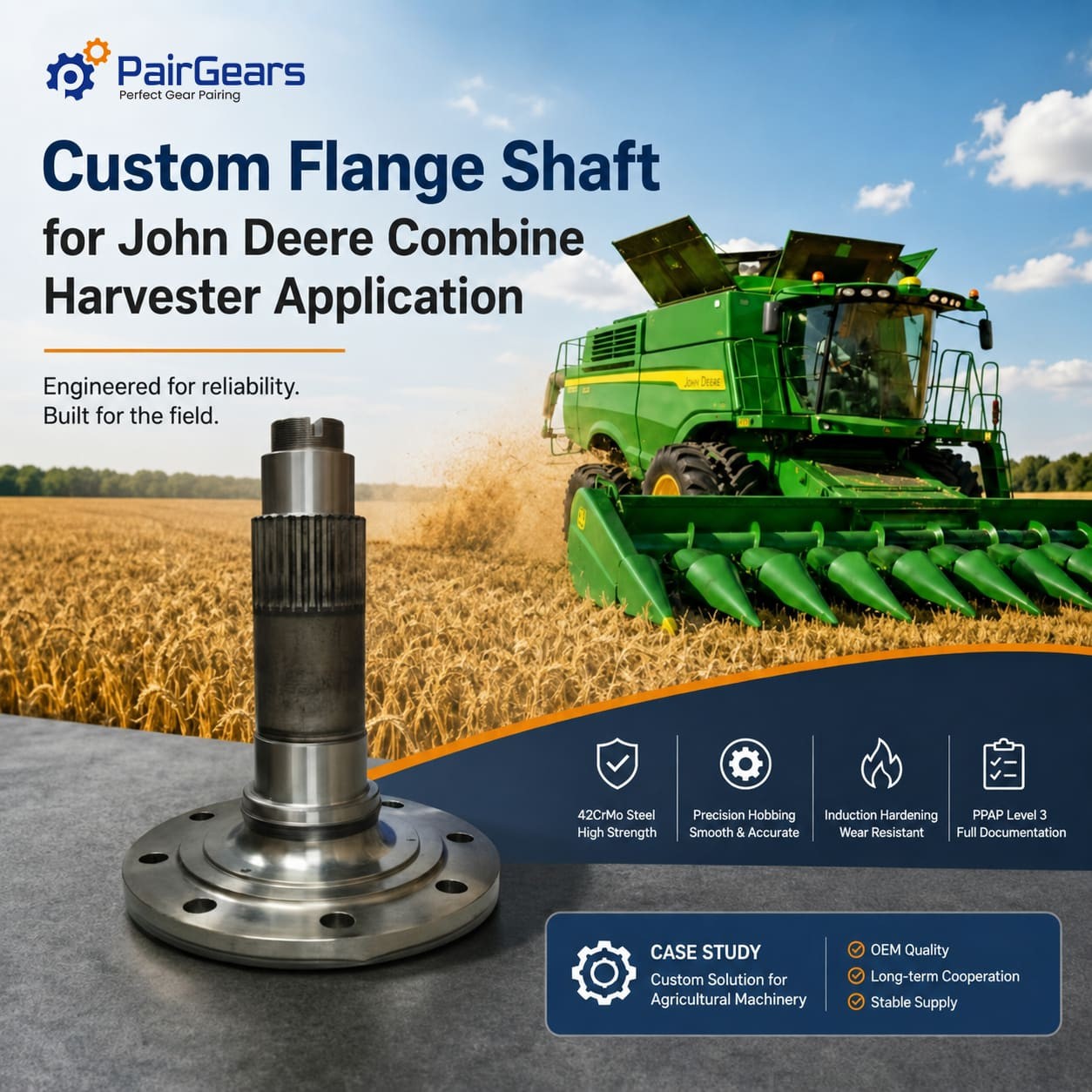
Quick Answer: What Did PairGears Solve in This Project?
PairGears supported a custom flange shaft project for a John Deere combine harvester application by solving four practical issues: low annual demand versus forging MOQ, PPAP Level 3 documentation, controlled induction hardening, and safe export packaging for a 44.5 kg heavy shaft.
Instead of treating the order as a simple machined part, PairGears built a controlled project route from material certificate, forged blank, turning, gear hobbing, heat treatment, grinding, inspection, rust prevention, and crate packaging.
Project Background
A flange shaft used in a combine harvester is not just a piece of steel. It has to handle torque, impact load, repeated field operation, outdoor storage, and long logistics time before installation.
In this project, the customer needed a heavy custom flange shaft for a John Deere combine harvester application. The part was not suitable for a simple catalogue purchase. It required material traceability, a stable machining route, heat treatment control, dimensional inspection, PPAP files, anti-rust protection, and a packaging design strong enough for export shipping.
PairGears, as a precision gear manufacturer and custom gear supplier, handled the project as a full manufacturing and quality-control case, not only as a one-time machining order.
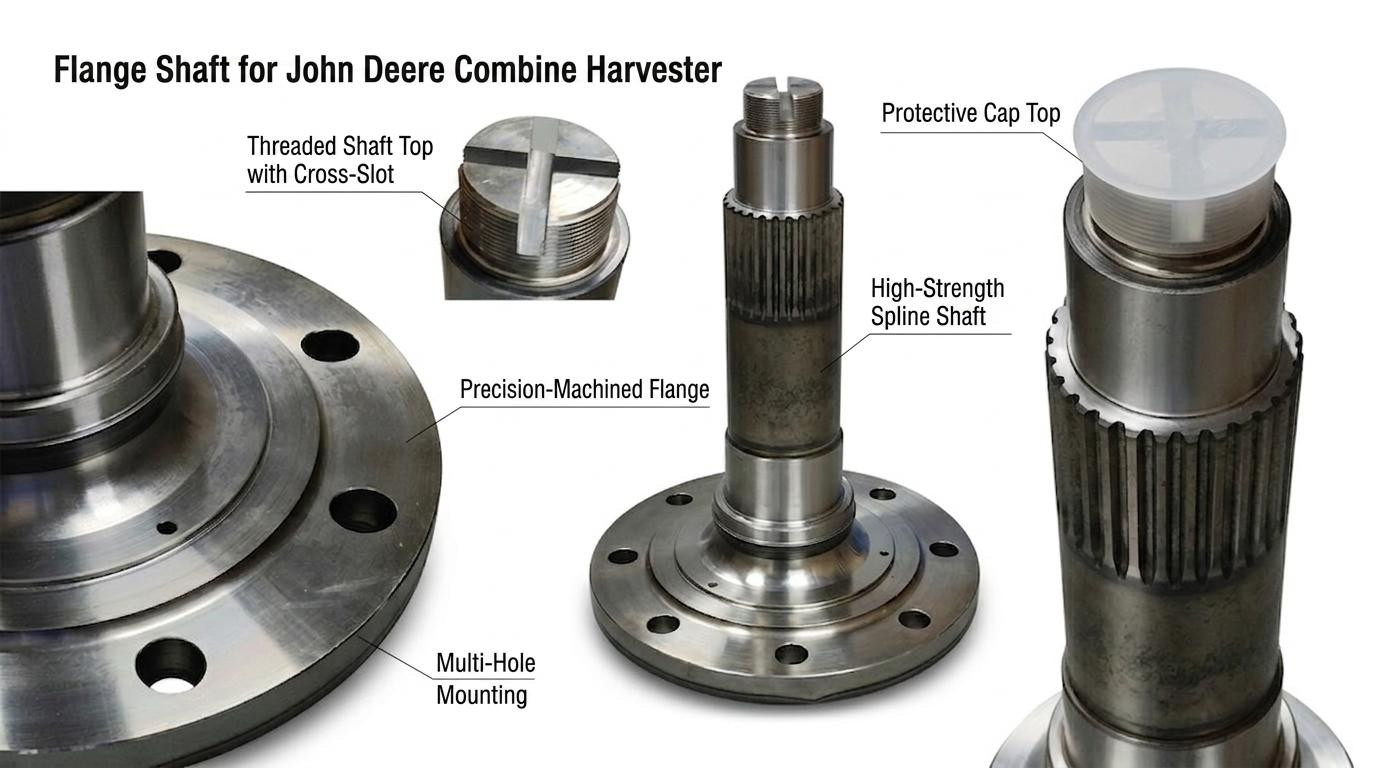
Why This Flange Shaft Project Was Not a Simple Order
Low Annual Demand
The annual demand was around 50 pieces, but the forged blank required a larger minimum quantity. If handled in the usual way, the customer would face either high inventory pressure or unstable lead time.
Heavy Part Weight
The part weight reached about 44.5 kg. A heavy shaft like this needs careful handling and packaging. Threads, flange faces, machined surfaces, and spline areas all need protection during shipment.
Quality Files Required
The customer needed PPAP-related documents. That meant the project had to show process planning, inspection records, material verification, and production-readiness evidence.
For buyers, this is the real question: Can the supplier manage the whole project risk, or can they only make one part? In this case, the value was in process control, documentation, and delivery planning.
How PairGears Reduced the Forged Blank MOQ Pressure
The customer did not need a very large quantity each year. However, the forged blank could not be prepared economically in very small batches. PairGears worked out a more practical supply plan: prepare a larger batch of forged blanks first, then machine and ship finished parts according to the customer's order schedule.
This approach helped the customer avoid buying too many finished parts at once, while keeping future production more stable. It also reduced repeated material sourcing risk and made later deliveries easier to plan.
| Issue | Risk for Buyer | PairGears Solution | Buyer Benefit |
|---|---|---|---|
| Annual demand around 50 pcs | Finished stock may become too high | Prepare forged blanks in advance | Less finished inventory pressure |
| Forging MOQ | Small orders may be difficult to launch | Use batch blank planning | More stable long-term supply |
| Repeat orders | Lead time may change every time | Machine in batches based on demand | Better production predictability |
Material Control: Starting From 42CrMo Steel
The flange shaft used 42CrMo / 42CrMoA steel. For a heavy agricultural machinery shaft, material control is one of the first risks to manage. If the steel source is not clear, later heat treatment and machining cannot fully compensate for that risk.
PairGears checked the material certificate and controlled the chemical composition and mechanical properties before machining. The control plan also included raw material inspection, spectrometer checking, macrostructure review, microstructure review, and mechanical property confirmation.
What Was Checked
- Steel grade and heat/batch information
- Chemical composition
- Mechanical properties
- Surface quality and physical size
- Traceability for later documentation
Why It Matters
A flange shaft may look correct after machining, but material instability can still create problems after heat treatment, during assembly, or after long service in the field. Material traceability helps reduce this hidden risk.
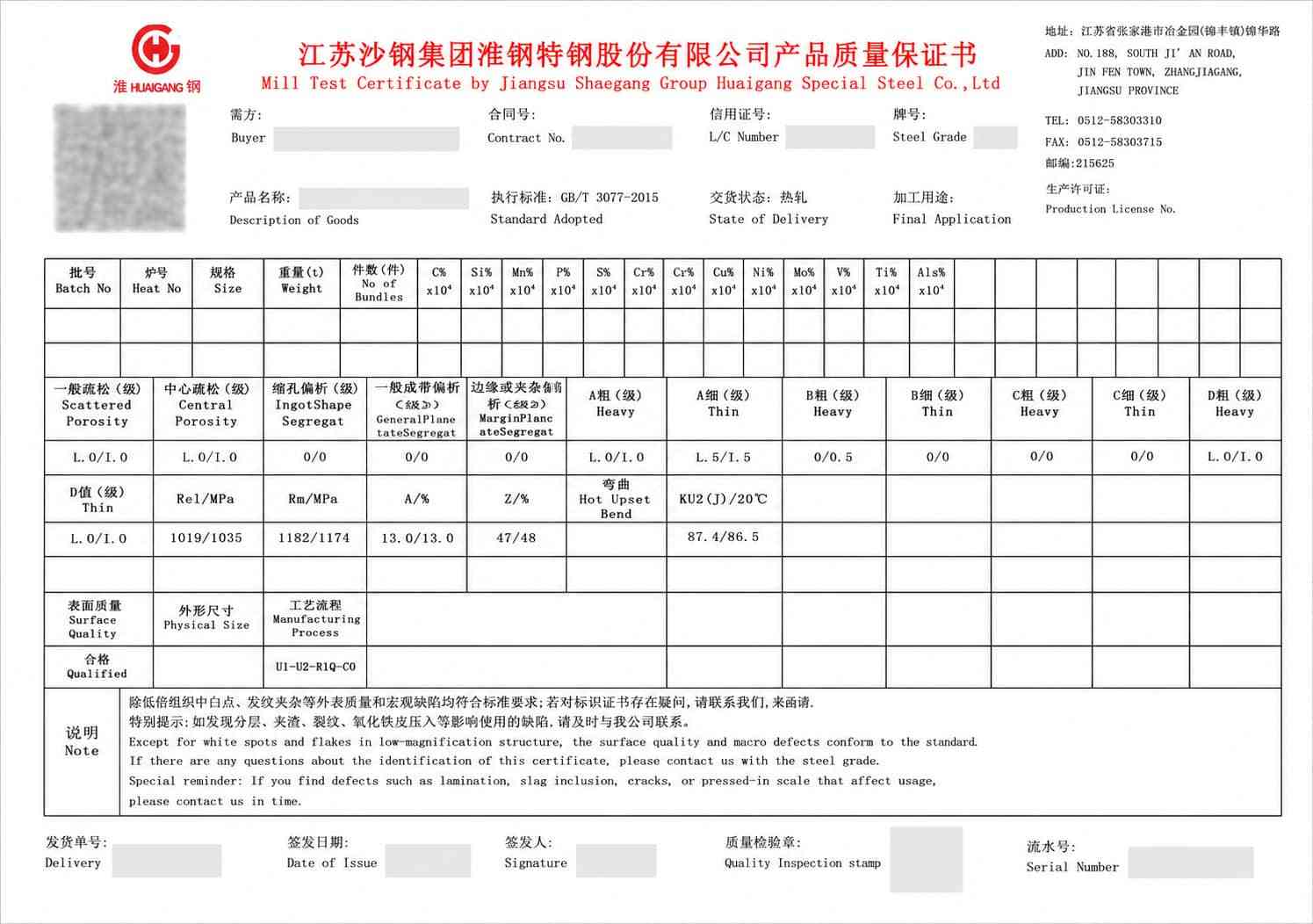 Suggested image: cropped material certificate or a clean material-control graphic.
Manufacturing Route: From Forging to Final Packaging
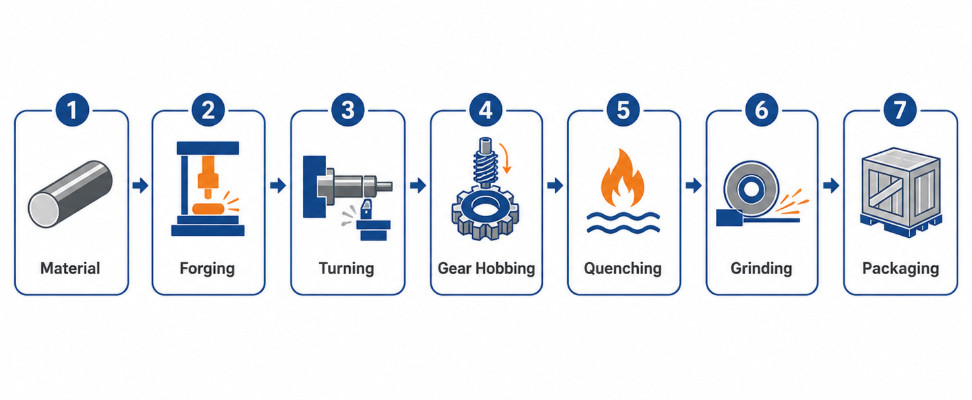
This flange shaft needed more than turning. The process included forged blank preparation, normalizing, multiple turning operations, quenching and tempering, spline or gear hobbing, cross-slot milling, induction hardening, tempering, OD grinding, laser marking, cleaning, packaging, and warehousing.
This route gave the project a clear logic: first secure the material and blank, then build the main geometry, then machine the functional tooth/spline area, then harden the required surfaces, then finish key diameters by grinding.
Heat Treatment Control: Hardness Where It Is Needed
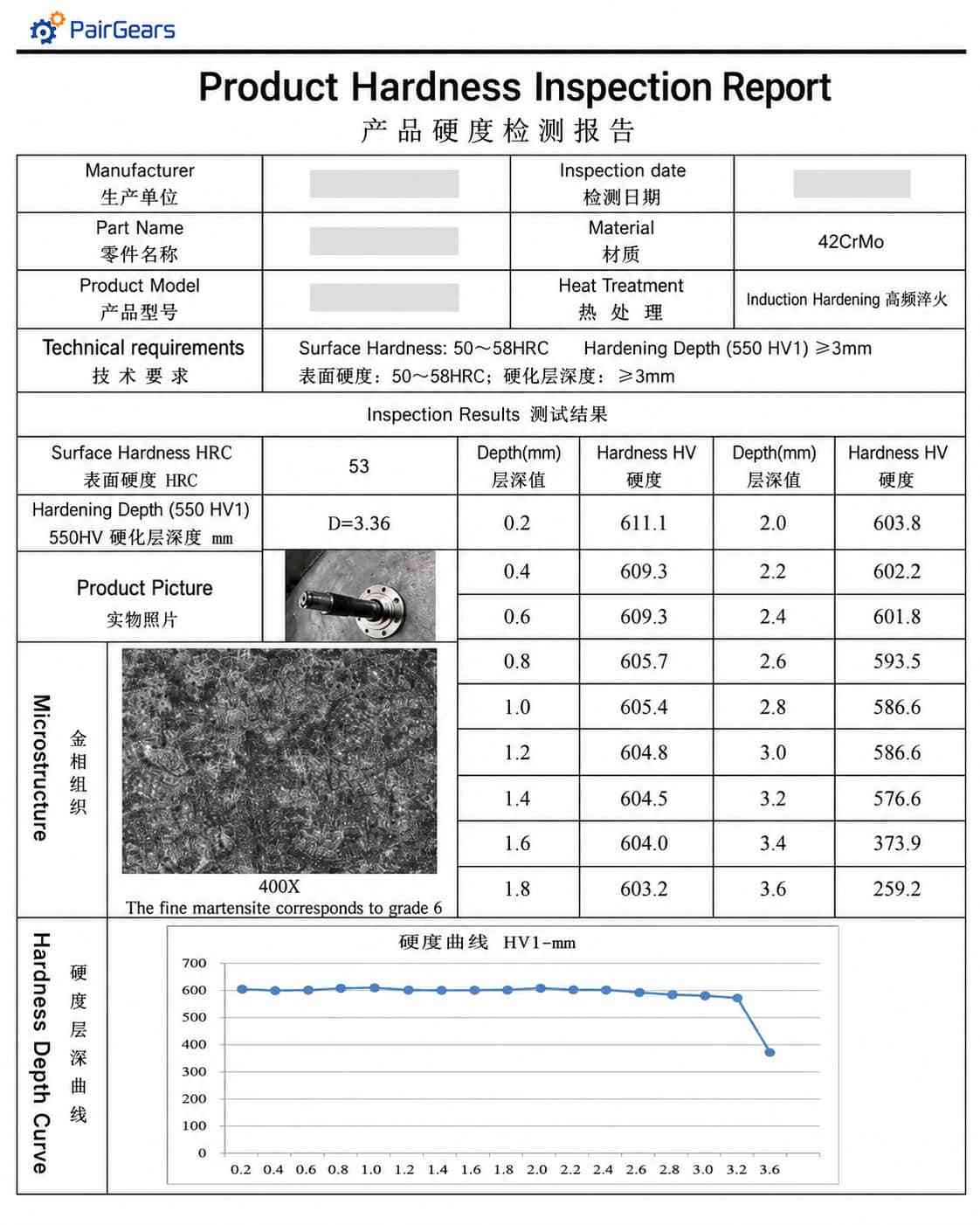
Not every area of a flange shaft needs the same hardness. Some sections need strength and toughness. Other working areas need higher surface hardness and enough case depth to resist wear.
In this project, the process route included quenching and tempering, followed by induction hardening on specific areas. The technical requirement included surface hardness of 50–58 HRC and different hardening depth requirements, including 2 mm and 3 mm zones.
The hardness inspection results recorded surface hardness around 53 HRC. One tested area showed a 550 HV1 hardening depth of about 3.36 mm, and another tested area showed a hardening depth of about 2.13 mm. These records help connect the production process with the drawing requirement.
For buyers, “heat treated” is not enough. The useful question is: which area was heat treated, what hardness was required, and what test result was recorded?
Gear Hobbing and Key Machining Details
This part included a functional tooth or spline-related area. The project route used gear hobbing, with control points such as measurement over pins, root circle diameter, radial runout, tooth length, and visual tooth-surface condition.
This is important because a shaft can pass general outer diameter checks but still fail during assembly if the toothed area, spline profile, runout, or related locating surface is not controlled properly.
| Control Area | Typical Concern | Why It Matters |
|---|---|---|
| Measurement over pins | Tooth thickness and fit | Affects mating and assembly feel |
| Radial runout | Rotational stability | Reduces vibration and uneven load |
| Tooth surface | Nicks, dents, or damaged teeth | Prevents early wear or assembly complaints |
| Ground diameters | Fit and alignment | Controls bearing or mating location accuracy |
Dimensional Inspection: Checking Before the Problem Reaches Assembly
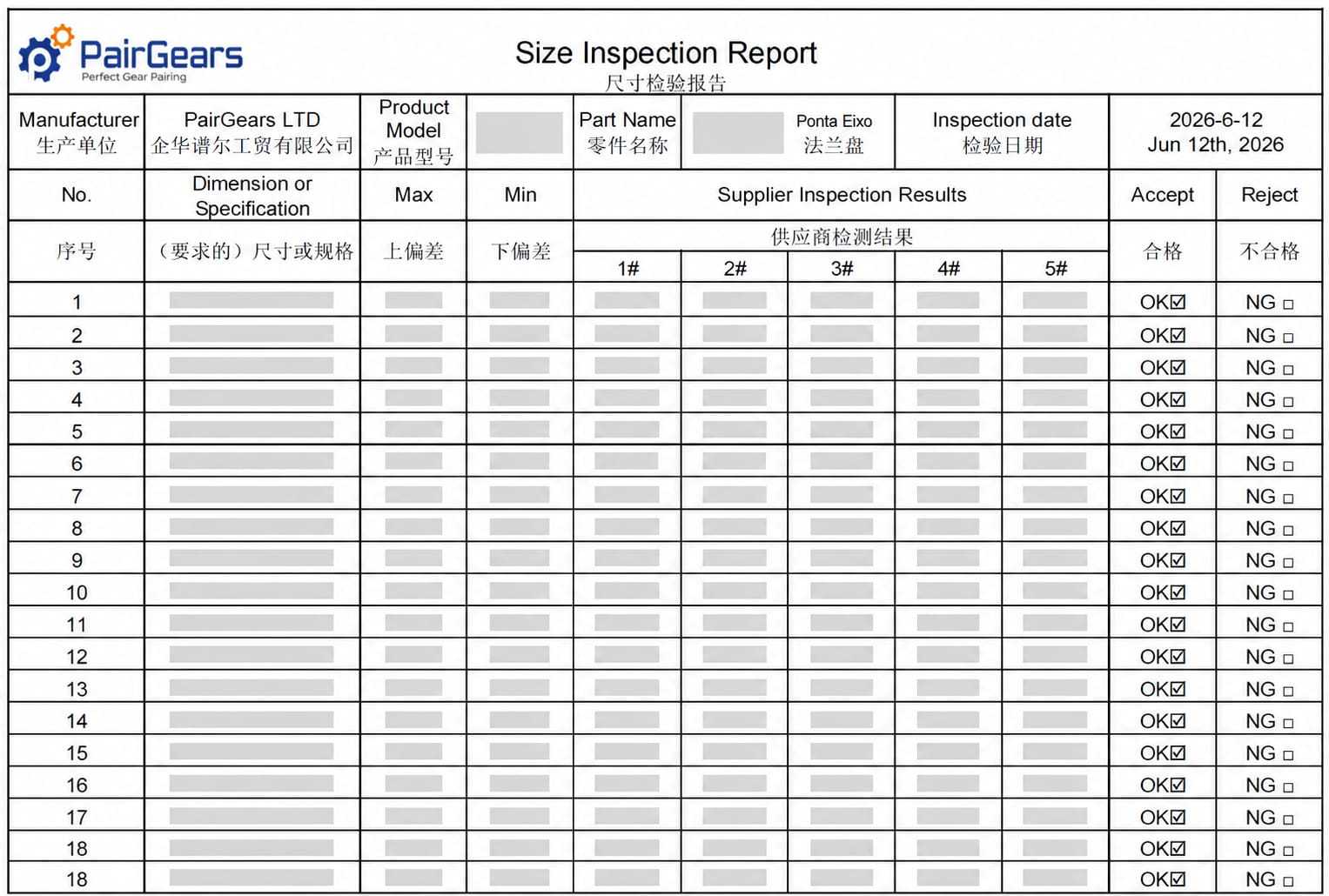
PairGears inspected sample parts before shipment. The dimensional inspection report recorded multiple dimensions across five pieces, including outside diameters, axial lengths, radii, runout items, thread, tooth parameters, and other functional features.
Many of these dimensions are not only “drawing numbers.” They are linked to real assembly risks. If a shaft diameter, flange thickness, thread, tooth feature, or runout value moves out of tolerance, the part may still look fine, but it may not assemble smoothly or work reliably.
Inspection Covered
- Major outside diameters
- Axial lengths and flange thickness
- Thread and chamfer features
- Runout-related requirements
- Tooth and spline-related checks
Buyer Value
The customer did not have to judge the sample only by photos. The inspection report gave measurable evidence before approving production or shipment.
PPAP Level 3 Support for a More Controlled Supply Chain
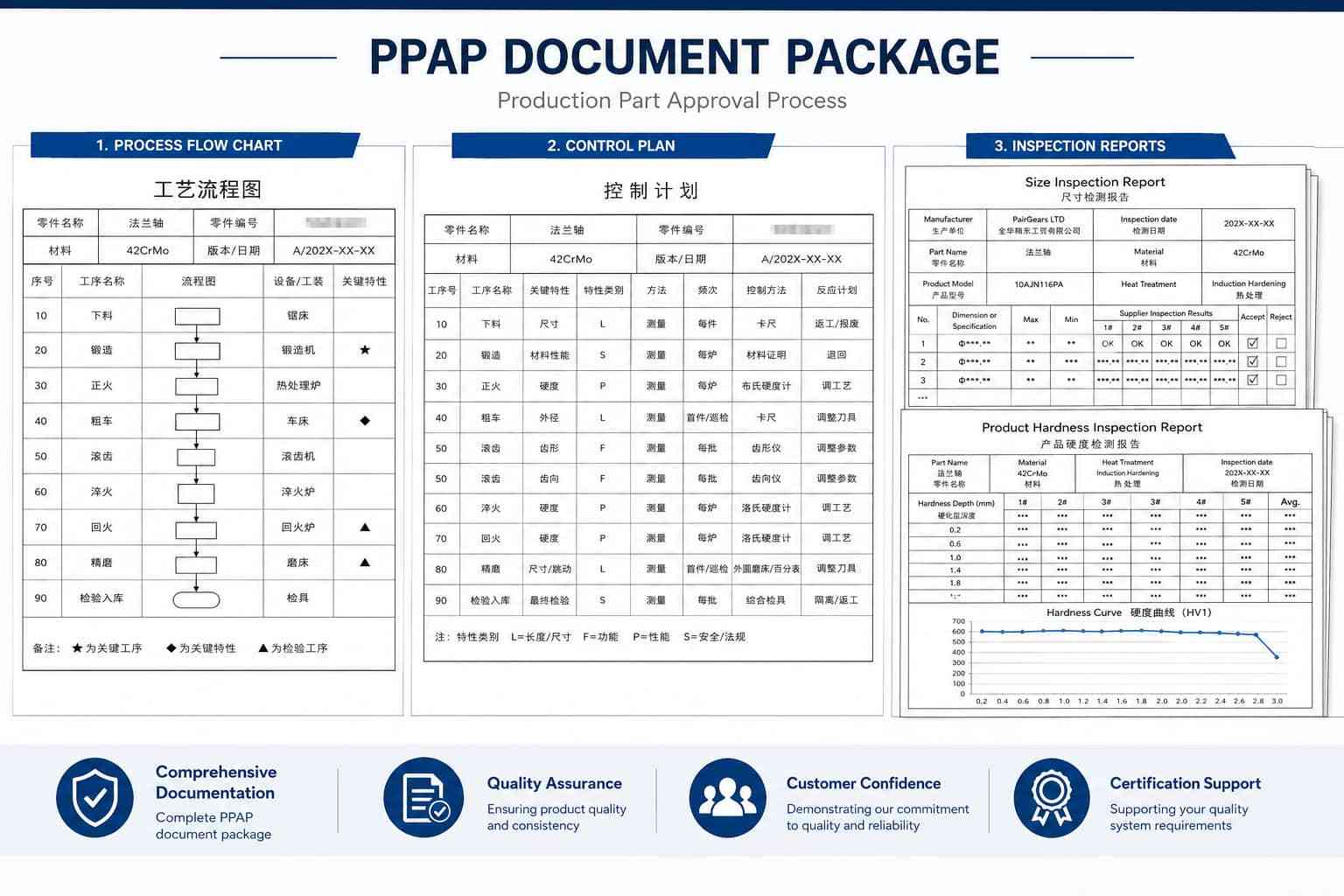
Some agricultural machinery projects require more than samples. Buyers may need a structured submission package to confirm that the supplier has a planned and repeatable process. In this project, PairGears supported PPAP-related documentation for the flange shaft.
PPAP is widely used to show that engineering records and specification requirements can be consistently met. For a heavy flange shaft project, this type of documentation helps the buyer review risk before regular supply.
| Document Type | What It Proves | How It Helps the Buyer |
|---|---|---|
| Process Flow Diagram | Each production step is defined | Shows the route from material to shipment |
| Control Plan | Key checks and reaction plans are listed | Reduces uncertainty before batch supply |
| Dimensional Results | Sample dimensions are measured | Supports sample approval and assembly review |
| Material & Test Results | Material and heat treatment are verified | Links product performance to test evidence |
| PSW / Submission File | Part submission information is summarized | Helps the customer manage internal approval |
Anti-Rust Protection and Export Packaging
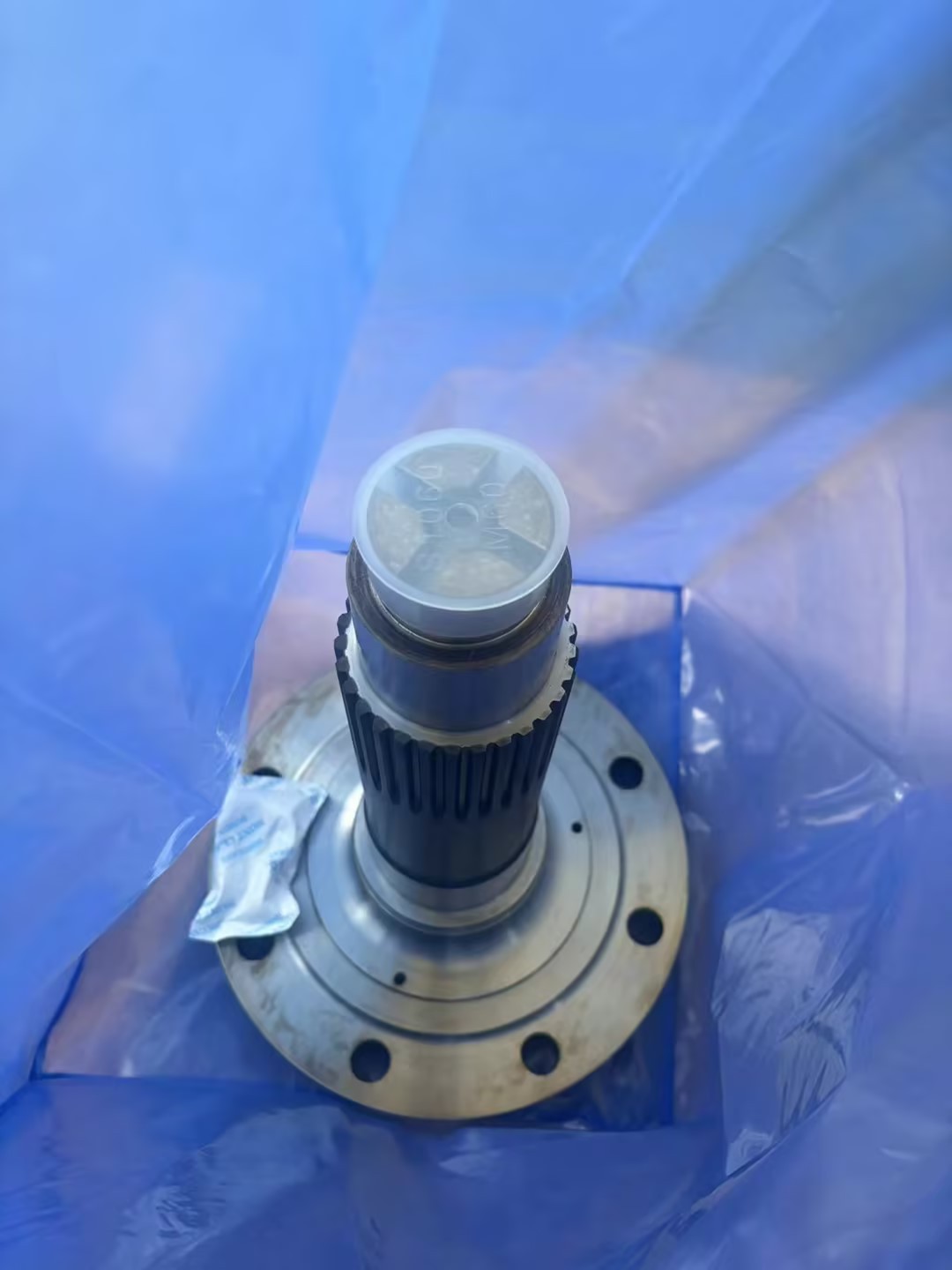
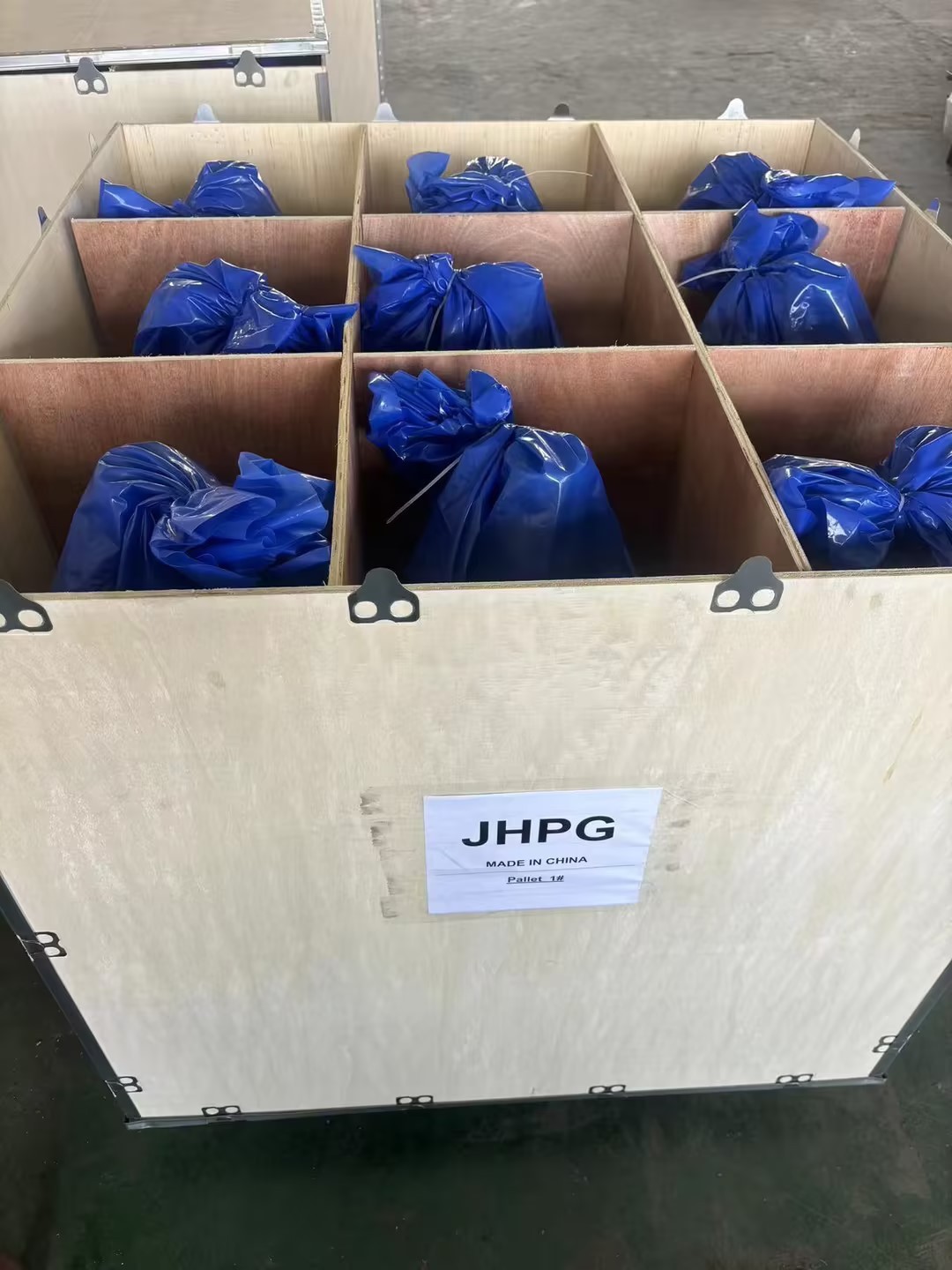
This was a heavy part, with each shaft weighing about 44.5 kg. For export shipment, the packaging had to protect machined surfaces, tooth/spline areas, threads, and the overall part position inside the crate.
PairGears used anti-rust oil, VCI bags, desiccant, protective wrapping, separated wooden partitions, and plywood crates. The packaging design kept each part in its own space, which helped reduce movement during transportation.
Packaging Steps Used in This Project
- Apply rust preventive oil to the required surfaces.
- Protect key areas such as threads and machined surfaces.
- Place the part into a VCI bag with desiccant.
- Use separated partitions to prevent part-to-part contact.
- Load the parts by layer into a plywood crate.
- Seal, strap, and mark the crate for export shipment.
For heavy machined shafts, packaging is not a minor detail. Good packaging reduces the chance of rust, scratches, dents, thread damage, and customer-side unpacking complaints.
What Buyers Can Learn From This Case
A custom flange shaft for agricultural machinery should not be purchased by price alone. The real cost often appears later if the part fails inspection, rusts during transport, cannot be assembled, or lacks the documents required by the customer’s internal quality team.
| Buyer Should Confirm | Why It Matters | What PairGears Provided in This Case |
|---|---|---|
| Material certificate | Confirms steel grade and traceability | 42CrMo / 42CrMoA material documentation |
| Process route | Shows how the part will be made | Process flow from material inspection to packaging |
| Heat treatment data | Confirms hardness and case depth | Hardness inspection and depth records |
| Dimensional report | Reduces assembly risk | Sample inspection across key dimensions |
| PPAP support | Helps with quality approval | PPAP-related files and control plan support |
| Packaging plan | Protects parts during export shipment | VCI bags, desiccant, partitions, and plywood crates |
Why PairGears for Custom Agricultural Machinery Shafts?
PairGears supports custom gears and shafts for agricultural machinery, heavy-duty trucks, construction equipment, and electric vehicle drivetrain applications. For projects involving OEM replacement parts, custom gear shafts, flange shafts, spline shafts, and transmission-related parts, our team focuses on both manufacturing and project control.
Buyers can send drawings, samples, OEM numbers, material requirements, heat treatment requirements, annual demand, batch quantity, inspection needs, and packaging requirements. PairGears can then review the process route and prepare a practical supply plan.
Engineering Review
We review drawings, functional areas, heat treatment needs, tooth or spline features, and possible production risks before quoting.
Controlled Production
We manage forging, turning, gear hobbing, hardening, grinding, inspection, and packaging as one connected process.
Clear Communication
We provide practical feedback on material, MOQ, sample approval, PPAP documentation, and long-term supply planning.
Final Result
This project was not only about making a flange shaft. It was about helping the customer move from a complex requirement to a controlled supply solution.
PairGears helped manage the forged blank plan, material verification, process route, induction hardening, dimensional inspection, PPAP documentation, anti-rust protection, and export packaging. This made the project easier for the buyer to review, approve, and repeat in future orders.
Have a Similar Flange Shaft or Gear Shaft Project?
Send your drawing, sample, OEM number, material requirement, heat treatment request, annual demand, and packaging needs. PairGears can help check the process route and prepare a clear quotation.
FAQ
Can PairGears support low annual demand flange shaft projects?
Yes. For projects with low annual demand but higher forged blank MOQ, PairGears can review whether a forged blank stock and batch machining plan is practical. This can help reduce finished-product inventory pressure while keeping later supply more stable.
What information is needed for a custom flange shaft quote?
Buyers should provide 2D drawings, 3D models if available, material requirements, heat treatment requirements, tooth or spline parameters, annual demand, batch quantity, inspection needs, and packaging requirements.
Can PairGears provide PPAP-related documents?
PairGears can support PPAP-related documentation when the project requires it, including process flow, control plan, dimensional results, material and test results, and other agreed submission files.
Why is induction hardening important for a flange shaft?
Induction hardening can improve surface hardness in selected working areas while keeping other areas suitable for strength and toughness. The key is to confirm both hardness and hardening depth, not just state that the part was heat treated.
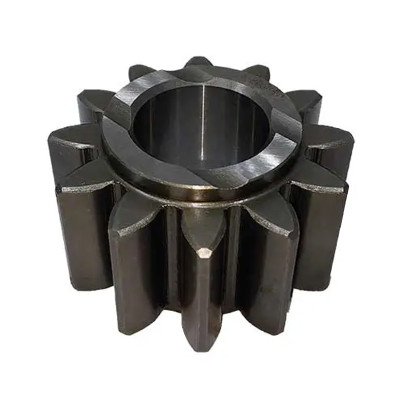
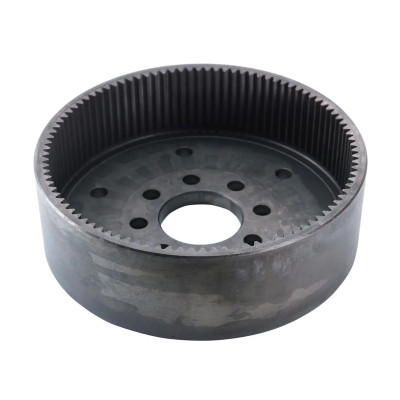
Are you looking for a reliable precision gear manufacturer?
We can quickly provide customers with market analysis, technical support and customized services.- *Name
- Phone
- *Title
- *Content