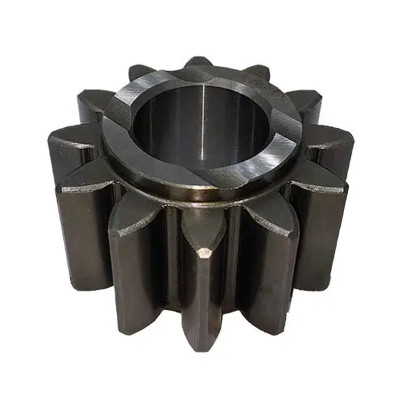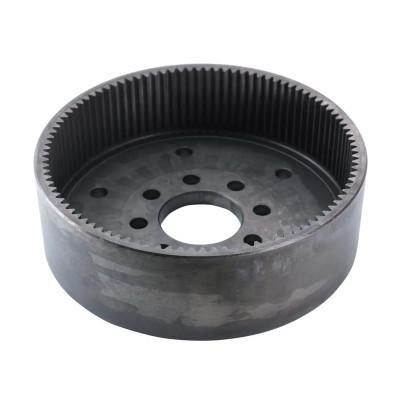
Gear Accuracy Inspection: What to Measure and Why
1. Introduction
Many teams only notice "gear accuracy" after a problem shows up: a gear feels tight in assembly, contact marks look off, or performance varies from batch to batch. That's why gear accuracy inspection matters—it turns "maybe" into measurable facts.
As a precision gear manufacturer and custom gear supplier, PairGears uses a practical inspection plan to control the errors that actually affect real assemblies. In this article, we explain what gear accuracy really means, what to measure first, and how to use inspection results to avoid surprises in agricultural machinery, heavy trucks, construction equipment, and EV-related systems.
2. What "Gear Accuracy" Means in Real Life
Gear accuracy is not one number. In most applications, it shows up in three simple outcomes:
Motion accuracy: Does the gear transmit rotation evenly, without periodic "speed up / slow down" behavior over one revolution?
Contact accuracy: Do the teeth share load in the right area, or is load concentrated on an edge or a corner?
Running smoothness: Does the gear engage consistently, or does it show impact, fluctuation, or unstable meshing?
You don't need to memorize every standard term to use this well. The key is to connect inspection items to these outcomes.
3. The Checks That Matter Most in Gear Accuracy Inspection
Below are the inspection items that solve most real-world issues. If you only have time and budget for a focused plan, start here.
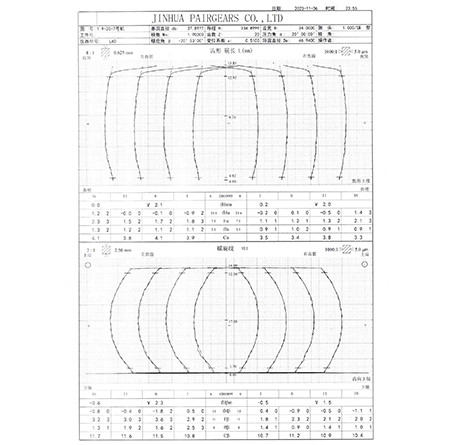
3.1 Profile deviation (tooth shape along height)
This tells you whether the involute tooth form matches the intended shape. If profile is off, contact shifts up or down the tooth, and load concentrates where you don't want it.
3.2 Lead deviation (tooth line across face width)
Lead controls whether contact is centered across face width. If lead is off, you often see edge contact, uneven wear, and inconsistent contact pattern.
3.3 Pitch deviations (tooth-to-tooth spacing)
Pitch errors are a common source of "periodic" behavior. Even if profile looks good, uneven spacing can create fluctuation over rotation and reduce consistency.
3.4 Runout and eccentricity behavior
Runout is not only a "geometry" issue—it often becomes a functional issue. It can produce one-revolution variation that shows up in rolling tests and in assembly feel.
3.5 Tooth thickness and backlash control
This is where drawings meet real assembly. Tooth thickness and backlash affect whether a gear fits smoothly, whether it binds, and whether it has unacceptable play.
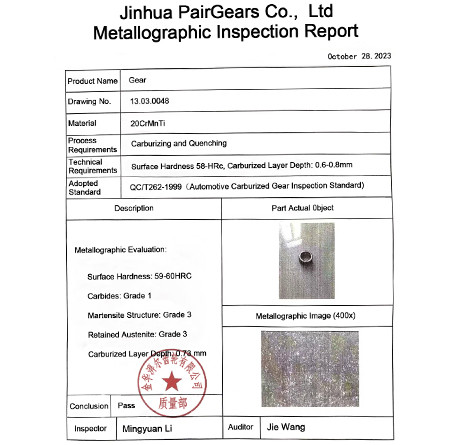
3.6 Heat treatment and surface condition
For hardened gears, hardness profile and surface condition strongly influence service life. Even with good geometry, incorrect hardening or distortion can push a gear out of its stable window.

4. Simple Mapping Table
This is often useful for RFQs and internal alignment:
| What you measure | What it affects in use | Typical symptom when out of control |
Profile deviation | Contact position along tooth height | Local wear, stress concentration, early surface damage |
Lead deviation | Load sharing across face width | Edge contact, uneven marks, inconsistent assembly feel |
Pitch deviations | Motion accuracy over rotation | Periodic variation, instability across batches |
| Runout | One-revolution variation | "Wobble"behavior, fit inconsistency, rolling variation |
| Tooth thickness / backlash | Assembly and serviceability | Too tight, too loose, hard insertion, visible play |
5. How PairGears Inspects Gears in Production
A good inspection plan answers two questions:
-What is the gear like by itself?
-How does it behave in mesh?
That's why we typically combine two approaches.
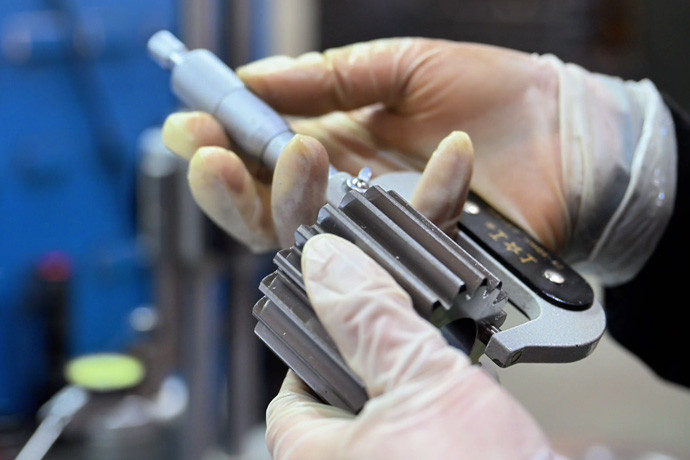
5.1 Elemental inspection (measure the gear directly)
This includes measuring profile, lead, pitch, runout, and related geometry items using suitable metrology equipment. Elemental inspection is the fastest way to locate what exactly is wrong.
Use this when:
-you need root-cause diagnosis
-you want to improve a process
-you need stable batch-to-batch control
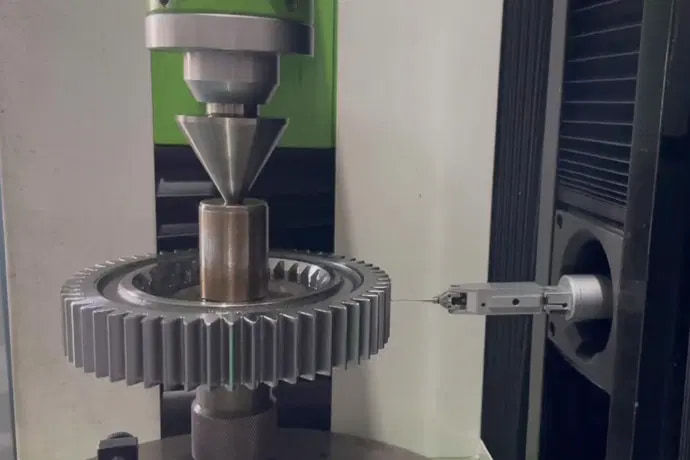
5.2 Composite testing (roll testing)
Roll testing checks how the gear behaves when it rolls with a mating gear. It’s a functional view of “does it run as expected” and it’s useful for screening and verification.
Use this when:
-you need a quick functional check on production lots,
-you want to confirm overall behavior (not only one element).
5.3 Contact pattern checking (simple but powerful)
For many applications, a clear contact pattern check is one of the easiest ways to catch alignment or lead-related risks early—especially when customers care about load sharing and long life.
In short: elemental inspection tells you where the error is, and roll/contact checks tell you how it behaves.

6. Turning Inspection Into Better Gears (Not Just Better Reports)
A common mistake is treating inspection as "final judgment" In good factories, inspection is feedback to the process.
At PairGears, we connect inspection results back to:
blank prep and datums (does runout start from a setup issue?)
tooth cutting strategy (is pitch behavior stable across batches?)
heat treatment control (did distortion shift lead/profile?)
finishing method (does grinding correct the real problem, or only the symptom?)
This is why two gears can both "pass" individual dimensions yet perform differently in assembly: the process chain and stability window were different.
A practical rule:
If the goal is fit and consistency, don't only chase a single number—control the small group of errors that affect your assembly reality.
7. What to Send PairGears for a Fast and Accurate Review
To evaluate a project efficiently, these inputs help most:
1. Gear drawing (or sample) and target accuracy requirement (ISO/AGMA or internal spec)
2. Mating part data (shaft/bore tolerances, center distance, mounting constraints)
3. Duty basics (torque range, speed range, duty cycle, shock loads if any)
4. Heat treatment requirement (type, hardness, case depth if applicable)
Your priority: fit, load sharing, stability across batches, service life
If you don't have a full drawing package, samples plus mating parts often reveal the real intent faster than long email threads.
8. Notes Across PairGears'Four Focus Sectors
We build gears for different environments, and inspection priorities shift slightly:
Agricultural machinery: Dust, seasonal duty, and field service often make fit stability and robust contact key.
Heavy truck: Long service life and torque demands often push contact accuracy and motion stability to the top.
Construction equipment: High load, low speed, shock conditions often emphasize distortion control and load sharing.
EV-related systems: Higher expectations for precision and repeatability often require tighter control of profile/lead/pitch and consistent functional checks.
The inspection items are similar, but the reason they matter changes by sector.
9. Conclusion
Gear accuracy becomes much easier to manage when everyone aligns on what to measure and how to accept it. PairGears combines direct geometry checks with practical functional verification so gears don't just look correct on paper—they behave consistently in real assemblies.
If you're starting a new gear program or troubleshooting fit and consistency issues, Contact Us with your drawing (or sample), mating part details, and duty basics. We'll help you build a simple inspection plan that supports stable results from prototype to production.
FAQ: Gear Accuracy Inspection
Q1: Which inspection items most often affect assembly fit?
Tooth thickness/backlash, runout behavior, and lead-related contact quality are common drivers of "too tight / too loose" complaints.
Q2: Do all projects need roll testing?
Not always. Roll testing is helpful for functional screening and confirmation. For diagnosing a process issue, elemental inspection is usually the fastest starting point.
Q3: We don't have a full standard callout. Can you still help?
Yes. Samples and mating parts often clarify the fit intent. We can measure, compare, and propose a controllable spec and inspection approach.
Q4: What's a practical first step if our batch consistency is poor?
Start by checking pitch-related behavior and runout trends across multiple parts, then review datums, setups, and heat treatment distortion. Many "random" problems are actually repeatable patterns.