Gear Ratio Explained: Speed and Torque Basics
1. Introduction
In power transmission, "gear ratio" is a short way to describe what a stage should do—speed up, slow down, or keep speed close to 1:1 while shifting torque. When the ratio target is clear, design decisions, supplier quotes, and inspection plans become far more consistent.
PairGears is a precision gear manufacturer supporting custom gear programs for Agricultural Machinery, Heavy-Duty Trucks, Construction Equipment, and EV drivetrains. This guide explains gear ratio in practical terms, how to calculate it quickly, and what to confirm with a custom gear supplier so your gear set behaves predictably in assembly and across repeat batches.
2. Gear ratio in one line
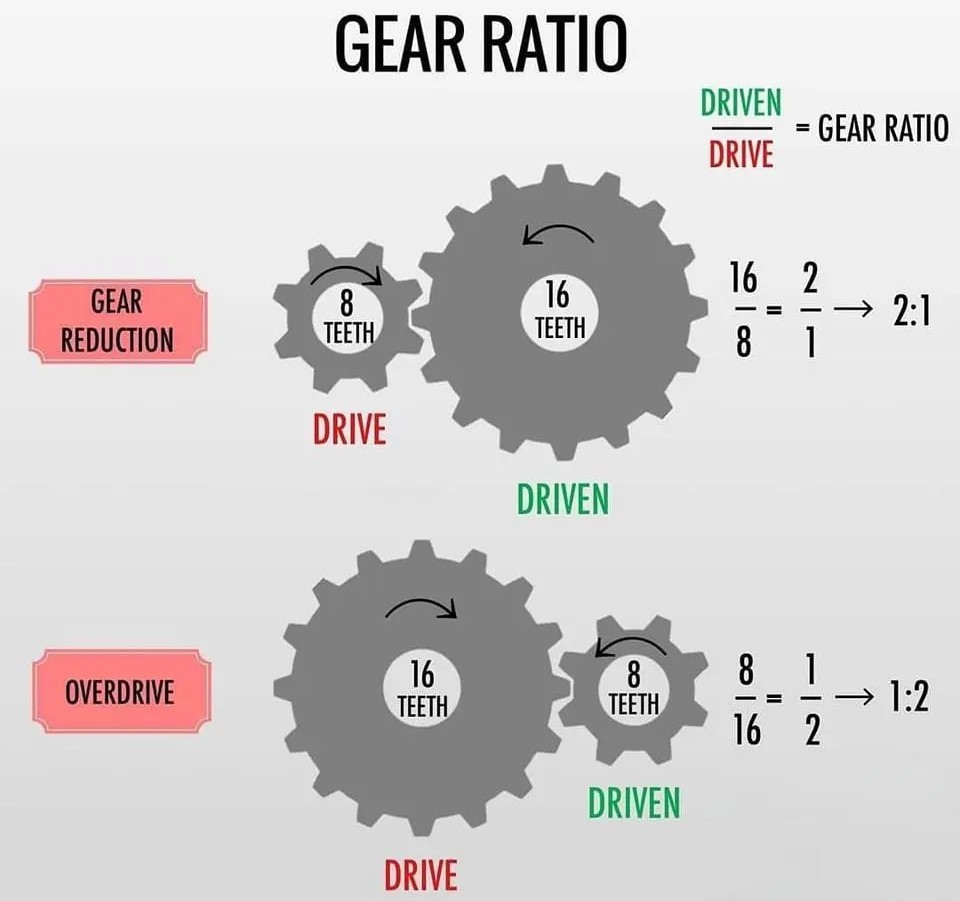
Gear ratio is the relationship between input speed and output speed in a gear pair or gear train, commonly determined by tooth count or pitch diameter.
3. Why ratio clarity saves time and rework
Gear ratio directly sets the operating point of the system. A higher reduction ratio lowers output speed and raises available torque (minus efficiency losses). A speed‑up ratio does the opposite. A small change in ratio can move the system into a different load and temperature regime—especially in continuous-duty applications.
Ratio targets also drive packaging and cost. They influence tooth count choices, outside diameter, center distance, and whether a single pair can do the job or a multi‑stage train is needed.
Finally, clear ratio conventions reduce quoting ambiguity. Label the driver and driven members, state how you write the ratio (driven/driver or driver/driven), and keep that convention consistent across drawings, and emails.
4. Common ratio patterns you will see
The table below shows practical "patterns" teams use when discussing gear ratio targets.
| Pattern | What it means | Typical intent | Notes |
| 1:1 (direct) | Input speed ≈ output speed | Transfer motion without changing speed | Often chosen for layout or packaging. |
| Reduction | Output speed decreases; torque increases | Increase torque at a lower speed | Common in reducers and final drives; confirm efficiency. |
| Speed‑up | Output speed increases; torque decreases | Raise speed when load allows | Often used for auxiliaries or light-load stages. |
Multi‑stage train | Overall ratio = product of stage ratios | Achieve large ratios in compact space | Define stage ratios and the overall ratio explicitly. |
Note: In a gear train, idler gears can change rotation direction but do not change the overall ratio.
5. Where gear ratios matter in our four sectors
● Agricultural machinery: gearbox stages and reducers where torque reserve and reliability matter.
● Heavy‑duty trucks: transmission and auxiliary stages where ratio consistency supports stable operation across loads.
● Construction equipment: drive and swing reducers that need stable torque output and predictable heat generation.
● EV drivetrains: compact reduction stages and actuation systems where ratio targets must match motor speed windows.
6. Numbers to lock before you quote
A "gear ratio" line item is most useful when it is tied to the parameters that control it and the way the gear is mounted.
| Item | What to state | Why it matters |
| Ratio convention | Driven/driver or driver/driven, plus label driver vs driven | Prevents reversed assumptions across teams. |
| Tooth count / pitch | Tooth counts (N) or pitch diameters | Fastest way to confirm ratio feasibility. |
| Speed & torque range | Approx. input speed and required output torque | Validates whether a single stage is realistic. |
Efficiency assumption | Target efficiency or a conservative estimate | Real output torque = input × ratio × efficiency. |
Mounting datums | Which bore/shaft seats and faces locate the gear | Controls mesh position repeatability across batches. |
Tooth-geometry checks | Profile/lead/pitch/runout checks as needed | Avoids "looks OK" parts that fail in assembly or test. |
Quick reference: output speed is approximately input speed divided by the ratio; output torque is approximately input torque times ratio times efficiency.
7. Three quick ways to calculate ratio
7.1 Tooth count method
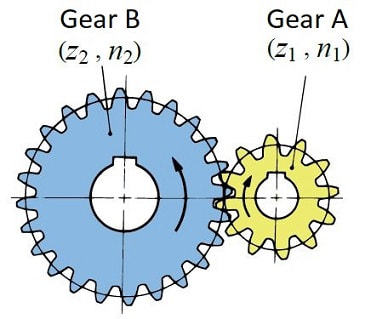
(most common for RFQs): if you define r = N₂/N₁, divide driven teeth by driver teeth. This gives the speed ratio magnitude when the gears mesh correctly and share the same module/DP.7.2 Pitch diameter method:
if you only have pitch diameters, the ratio magnitude can be computed as D₂/D₁. This is often used early in layout when tooth counts are not final.7.3 Speed method
(validation in testing): measure input and output speeds and compute r = Sᵢ/Sₒ (with your convention noted). This is useful when verifying assembled systems or diagnosing why a gearbox does not meet a target.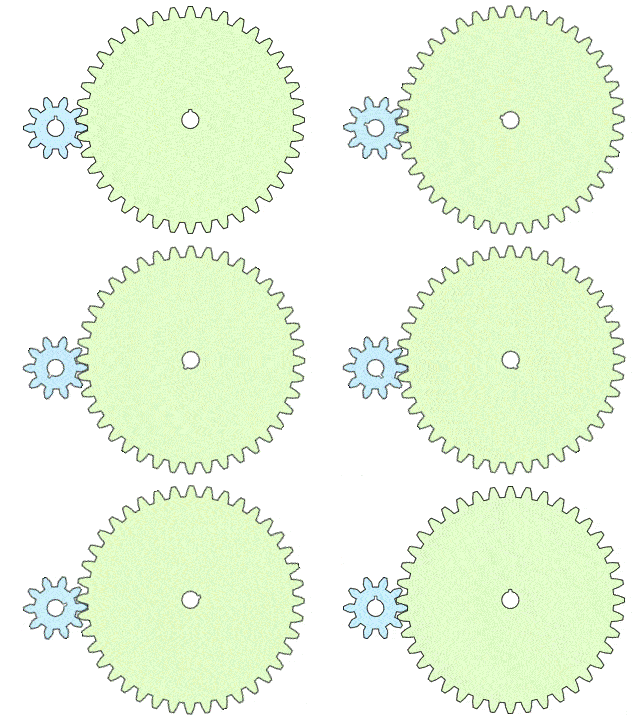
Quick example you can reuse in an RFQ
Example (tooth count method): Driver gear N₁ = 18 teeth, driven gear N₂ = 54 teeth. If you define ratio r = N₂/N₁, then r = 54/18 = 3.0 (3:1 reduction).
If input speed is 1800 rpm, the output speed is about 1800/3 = 600 rpm. If input torque is 50 N·m and you assume 95% efficiency, the output torque is about 50 × 3 × 0.95 ≈ 143 N·m. Use your own efficiency target when you quote or verify performance.
8. Common mistakes that create avoidable surprises
● Mixing ratio conventions (driver/driven vs driven/driver) without labeling the input and output members.
● Forgetting efficiency and losses when estimating output torque, especially in high-load or multi-stage trains.
● Assuming an idler gear changes the ratio; in most simple trains it changes direction, not the overall ratio.
● Confirming tooth count but not confirming mounting datums and runout control, which can shift contact and change behavior.
● Quoting a ratio without stating center distance or envelope limits, then discovering the gear sizes cannot fit the housing.
9. What you gain when ratio targets are clear
| Benefit | What improves | What it reduces |
| Faster alignment | RFQ intent matches the design goal | Back-and-forth on basic assumptions |
| More stable builds | Assembly behavior is more repeatable | Late-stage rework and hand fitting |
| Predictable cost | Sizing and stage count are decided earlier | Re-quoting and redesign loops |
Cleaner validation | Inspection focuses on ratio drivers (teeth + datums) | Test failures caused by avoidable geometry drift |
Inspection focus that supports ratio consistency
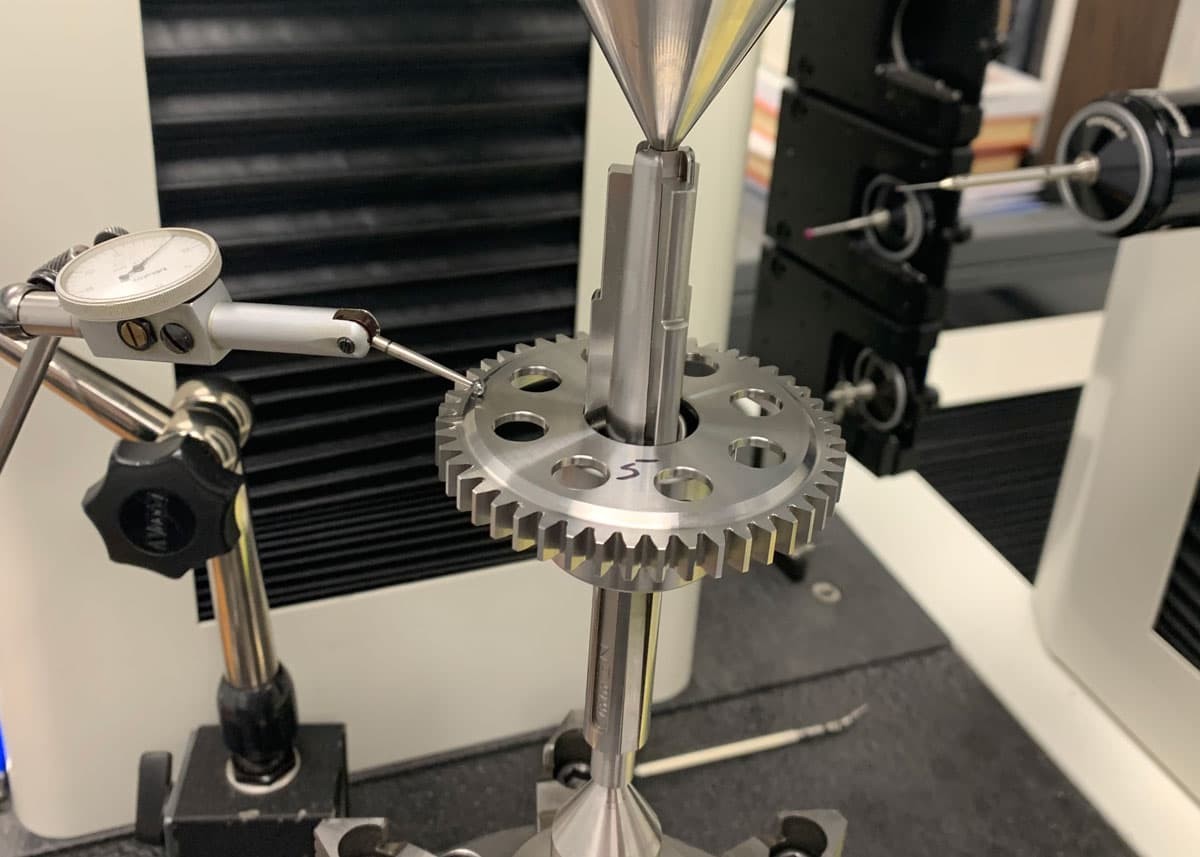
A ratio target can be met on paper and still feel inconsistent in assembly if tooth geometry and datums drift. For example, runout at the mounting bore/shaft seat can move the tooth contact position even when tooth count is correct.
If your application is sensitive, align with your supplier on which checks matter most: tooth profile and lead, pitch variation, runout to datums, and basic fit dimensions. The goal is not "more inspection", but the right inspection that protects repeatability.
10. How to align with a supplier on ratio and manufacturability
1) State the ratio and your convention, and label driver vs driven on the drawing or in the email.
2) Share the application (transmission/differential/reducer/actuator), plus approximate torque and speed range.
3) If this is a paired gear set, define the mounting datums that locate bearings and the face that sets axial position.
4) Confirm whether you need a single-stage pair or a multi-stage train, and share center distance / envelope limits if known.
5) Agree on tooth‑geometry acceptance checks (profile/lead/pitch/runout) that match the risk of your application.
11. Why choose PairGears
As a precision gear manufacturer, we support ratio-driven programs from prototypes to repeat batches. We focus on the details that keep ratio performance stable after assembly: datums, runout control, tooth geometry verification, and process repeatability.
We can review your ratio target together with packaging and inspection scope, then recommend a practical route that balances cost, tolerance, and delivery risk for your application sector.
12. FAQ
Q: Is gear ratio only about tooth count?
A: Tooth count is the fastest method for a simple pair, but ratio can also be expressed by pitch diameter or measured speed relationship.
Q: If I change the ratio, will torque always change by the same factor?
A: In practice, losses matter. A common estimate is output torque ≈ input torque × ratio × efficiency.
Q: Why do teams write ratios differently?
A: Some use driven/driver and others use driver/driven. The fix is to pick one convention and label driver vs driven clearly.
Q: Do idler gears change the overall ratio?
A: In many simple trains, an idler changes direction and spacing but not the overall ratio. Confirm with the full gear train definition.
Q: What should I send for a quote besides the ratio?
A: Gear type, module/DP, pressure angle, face width, material/heat treat expectation, mounting datums, and inspection scope.
13. Conclusion
Gear ratio is simple to calculate, but it only delivers stable results when it is defined with clear conventions and tied to real assembly datums. When you align ratio targets with packaging, inspection checks, and a realistic manufacturing route, you reduce surprises from first article to repeat orders.
If you have a drawing, sample, or OEM number, contact our team and share your ratio convention, torque/speed window, and any packaging limits. Contact Us, and we can help confirm a practical ratio approach and deliver gears that assemble smoothly and perform consistently across batches.