Practical Guide to Spur Gear Backlash
Introduction
Backlash is one of those gear terms that is easy to misunderstand. Some buyers treat it as a sign of poor accuracy and ask suppliers to make it as small as possible. In real gear work, that is not always the right direction. A spur gear pair needs a controlled clearance so it can assemble, rotate, and tolerate real manufacturing and operating variation.
At PairGears, we manufacture custom precision gears and gear sets for Agricultural Machinery, Heavy-Duty Trucks, Construction Equipment, and EV drivetrains. In these projects, backlash is not judged by whether it is "big" or "small" alone. The important question is whether the backlash range fits the load, speed, center distance, tooth thickness, direction changes, and assembly condition.
What Is Spur Gear Backlash?
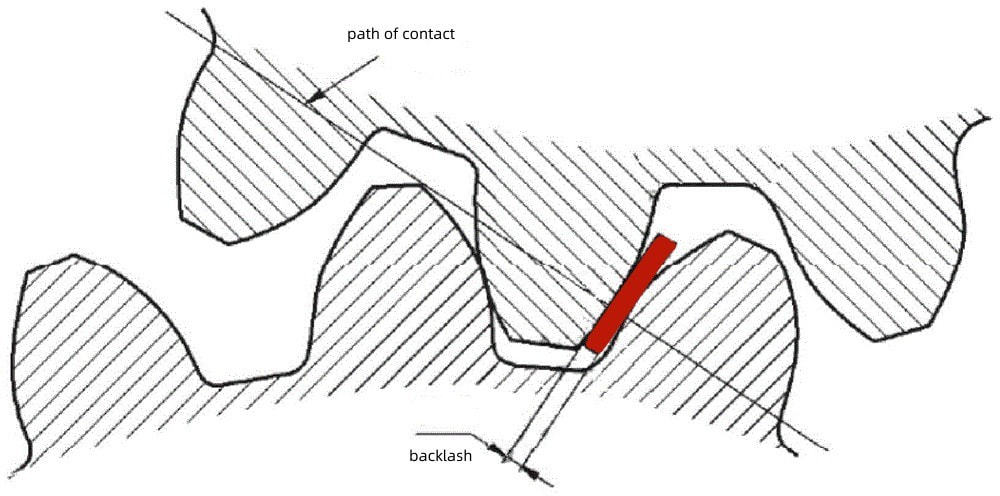
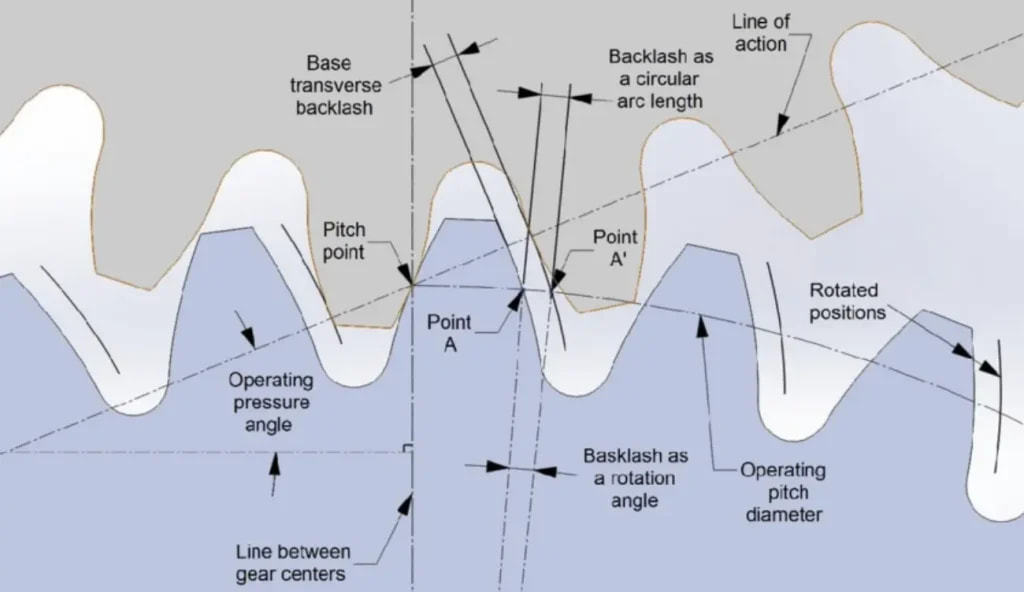
Spur gear backlash is the small clearance between the non-working flanks of two meshing gear teeth after assembly. It is a designed gap, not just a machining error.
Too little backlash can make the gear pair run tight, complicate assembly, or cause abnormal contact. Too much backlash can lead to impact, noise, vibration, or positioning error, especially during motion reversal.
Why Backlash Matters in Real Gear Projects
The useful question is not "Can backlash be removed?" but "What range is practical for this application?"
If backlash is too small, normal variation in tooth thickness, center distance, shaft support, and temperature can make the mesh tight. That may lead to hard running, heat buildup, or early wear.
If backlash is too large, the gear pair can knock during load changes. In reversing mechanisms, the output may lag before the opposite tooth flank contacts. This is why excessive backlash is often noticed in positioning systems, feed mechanisms, and equipment with frequent forward-reverse movement.
For most industrial spur gears, the goal is not zero backlash. The goal is stable backlash that stays within a useful range after manufacturing and assembly.
Main Types of Spur Gear Backlash
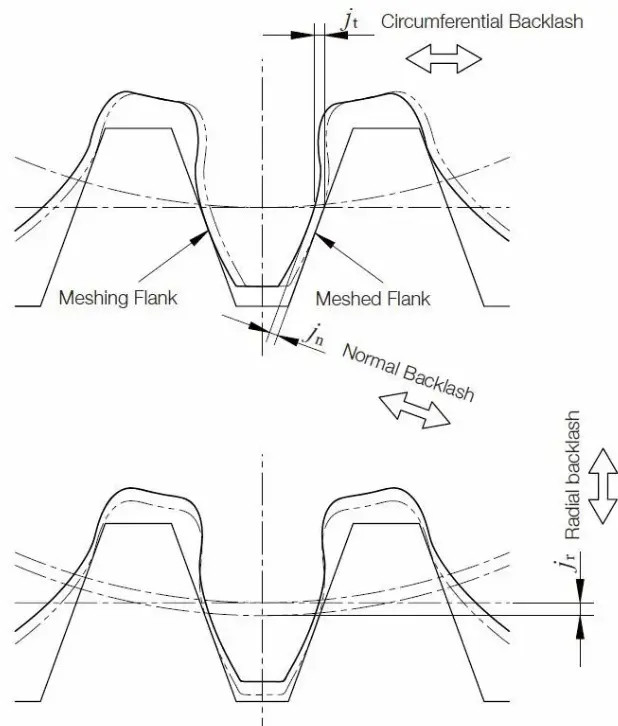
| Backlash type | Meaning | Common relationship | Main use |
| Normal backlash jn | Shortest clearance between non-working flanks in the normal direction | jn=jt×cosα | Design notes, drawing control, manufacturing discussion |
| Circular backlash jt | Arc movement at the pitch circle when one gear is fixed and the other is gently rocked | jt=jn/cosα | Assembly check and practical measurement |
| Radial-related clearance | Backlash change caused by center distance variation | Related to pressure angle and center distance change | Assembly adjustment and tolerance review |
Here α is the pressure angle. In formal projects, the drawing should make clear which backlash direction is required and how it should be inspected.
Where Backlash Control Matters Most
● Agricultural Machinery
Loads are often uneven, and operating environments are not always clean. Backlash should allow practical running margin without creating excessive impact.
● Heavy-Duty Trucks
High torque and long-life requirements mean backlash must be controlled together with tooth contact, center distance, and batch consistency.
● Construction Equipment
Shock loads and start-stop duty make excessive backlash easier to notice. Too little backlash can also become risky when the structure deflects under load.
● EV Drivetrains
Higher speed and tighter sound expectations make stable geometry, runout, and assembled backlash more important.
Different industries do not need the same backlash value. A good backlash target comes from the application, not from one universal number.
What to Check Before Defining Backlash
| Check item | What to confirm | Why it matters |
| Motion direction | One-way drive or frequent reversing | Reversing systems are more sensitive to backlash |
| Load condition | Steady load, shock load, or changing load | Affects impact and tooth contact behavior |
| Speed level | Low, medium, or high speed | Higher speed needs more stable running clearance |
Center distance | Nominal distance and tolerance | Directly changes assembled backlash |
Tooth thickness | Target tooth thickness and tolerance | Main manufacturing control for backlash |
Gear accuracy | ISO, DIN, AGMA, or project-specific grade | Influences pitch, runout, and mesh consistency |
Heat treatment | Distortion risk after hardening | Can change final tooth geometry |
Assembly method | Fixed center distance, shims, eccentric sleeve, adjustable housing | Determines whether backlash can be tuned after production |
A common RFQ mistake is to give module, tooth count, and material, but leave backlash undefined. For a basic quote that may be enough. For a controlled transmission project, it is not.
What Proper Backlash Control Improves
| Benefit | What improves | Practical result |
| Easier assembly | Tooth thickness and center distance match the real build | Less trial-and-error during installation |
| Lower tight-mesh risk | Clearance is not too small | More stable operation after loading |
| Better reversing behavior | Free movement is controlled | Less impact and better response |
Better repeatability | Backlash target is linked to inspection | More consistent batches |
Faster troubleshooting | Backlash is separated from profile, runout, and alignment issues | Easier root-cause analysis |
Backlash is only one part of mesh quality. A noisy gear pair may also suffer from profile error, runout, poor center distance control, shaft movement, or contact pattern problems. Clear backlash control helps narrow the investigation.
How to Determine a Practical Backlash Range
A practical backlash range should begin with the minimum clearance needed to absorb manufacturing tolerance, center distance variation, tooth thickness error, heat-treatment distortion, and assembly condition.
Light-load precision systems may require smaller backlash, but still enough to prevent tight running after assembly. Higher-speed systems need a range that supports stable operation without becoming too tight in service. Heavy-duty equipment, such as agricultural and construction machinery, often needs slightly more clearance to handle shock and load variation. For general machinery, a moderate backlash range is usually more reliable than an extremely tight value.
How Spur Gear Backlash Is Controlled
Tooth Thickness Control
The most common way to adjust backlash is to control tooth thickness. A thinner tooth usually increases backlash. A thicker tooth usually reduces it. That is why drawings should define tooth thickness limits or a clear backlash target when this item is important.
Center Distance Control
For external spur gears, increasing center distance usually increases backlash. Reducing center distance usually reduces it. For internal gear arrangements, the relationship should be checked based on the actual structure.
Profile Shift
Profile shift changes tooth thickness and mesh geometry. Positive profile shift usually increases tooth thickness and may reduce backlash. Negative profile shift usually reduces tooth thickness and may increase backlash. This must be reviewed together with strength and contact requirements.
Assembly Adjustment
Shims, eccentric sleeves, adjustable housings, and similar structures can help tune backlash during assembly. Adjustment should not be used blindly, because changing backlash can also change contact behavior and shaft support conditions.
Anti-Backlash Design
For systems with frequent reversing and high positioning requirements, an anti-backlash gear may be used. A common design splits one gear into two spring-loaded sections so the tooth flanks remain preloaded. This is more common in light-load or precision mechanisms, not in every heavy-duty drive.
Practical Supplier Review Points
● Define the backlash target clearly.
Avoid vague wording such as "small backlash." Give the measurement method and acceptable range.
● Confirm the control method.
Backlash may be controlled by tooth thickness, center distance, assembly adjustment, or a combination of these.
● Review reversing requirements.
One-way continuous operation and frequent reversing need different backlash logic.
● Check whether the gears are supplied as a pair.
Pairing matters when backlash, contact, and repeatability are sensitive.
● Ask what will be inspected.
Tooth thickness, runout, center distance, and assembled backlash should be reviewed together.
Why Choose Us
At PairGears, backlash is not treated as a simple number to minimize. We review it as part of the full gear system.
We focus on:
● Application-fit review for Agricultural Machinery, Heavy-Duty Trucks, Construction Equipment, and EV drivetrains
● Tooth thickness and center distance control for stable assembly
● Backlash ranges matched to duty cycle and direction changes
● Manufacturing and heat-treatment planning for repeatable geometry
● Inspection logic tied to real assembly performance
For many projects, the value is not only producing a gear with a specified backlash. It is making sure the backlash is practical, measurable, and repeatable in the final assembly.
FAQ
Q1: When Should Anti-Backlash Gears Be Used?
They are usually considered when a system has frequent forward-reverse movement and needs higher positioning accuracy. They are more common in light-load or precision mechanisms.
Q2: Can Spur Gear Backlash Be Zero?
In practical engineering, true zero backlash is usually not recommended. A gear pair needs clearance to tolerate manufacturing and assembly variation.
Q3: How Is Spur Gear Backlash Measured?
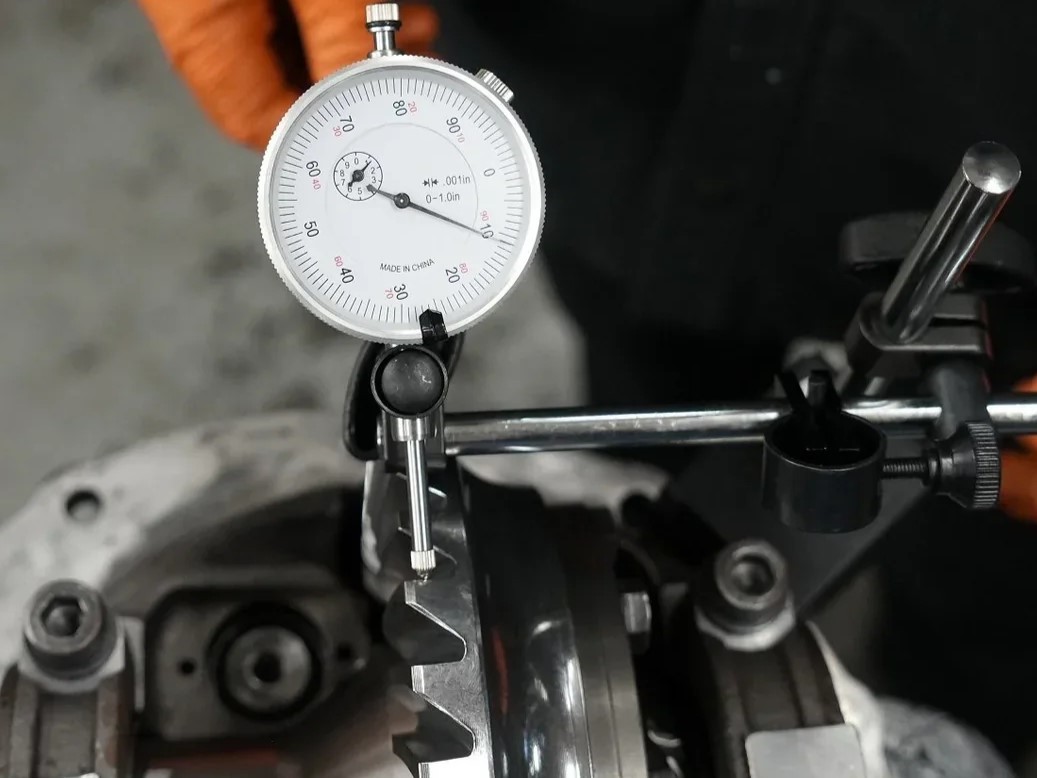
Common methods include dial indicator measurement, feeler gauge checks, and lead wire checks. Formal projects should follow the drawing or agreed inspection method.
Q4: How Is Spur Gear Backlash Different From Bevel Gear Backlash?
Spur gear backlash is often adjusted through tooth thickness and center distance. Bevel gear backlash also depends strongly on mounting distance, contact pattern, and matched-pair assembly.
Q5: Does Backlash Affect Transmission Accuracy?
Yes, especially in reversing or positioning applications. In one-way rotation, the influence may be much smaller.
Conclusion
Spur gear backlash is not an unnecessary gap. It is a working clearance that affects assembly, reversing response, noise, wear, and repeatability. Too much or too little backlash can both create problems. The right approach is to define a practical range based on tooth thickness, center distance, manufacturing route, and operating condition.
If you are developing a spur gear pair or troubleshooting noise, binding, reversing impact, or positioning error, you are welcome to Contact Us with your drawings, module or DP, tooth count, center distance, material, accuracy target, and operating conditions so we can help review a practical backlash control plan.