Rack and Pinion Gears in EV Steering Systems
Introduction
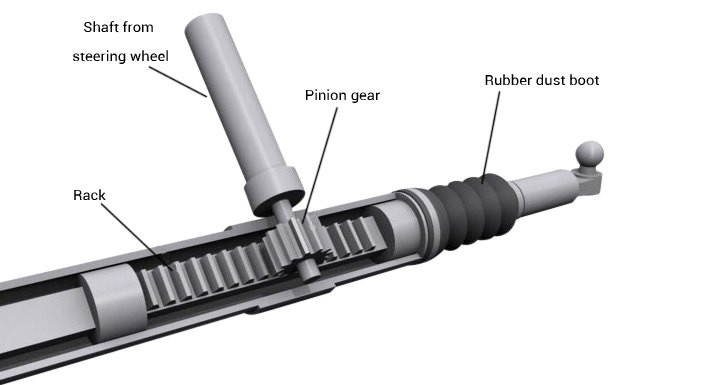
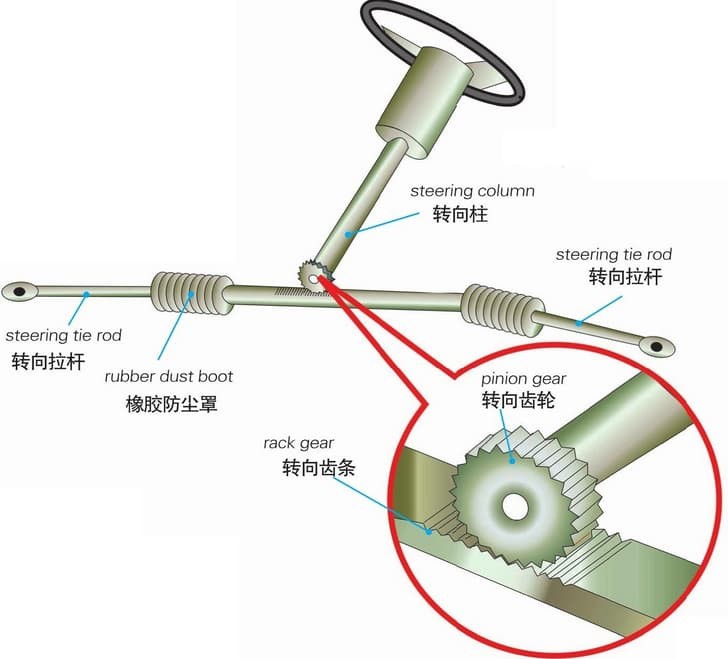
In an EV steering system, rack and pinion gears perform a simple but important motion conversion: a rotating pinion gear meshes with a straight toothed rack and moves it left or right. The principle is easy to understand, but the real performance depends on much more than the tooth count or outside size. Tooth geometry, backlash, friction, surface finish, material, heat treatment, support stiffness, and assembly consistency all affect how smoothly the rack moves.
At PairGears, we manufacture custom precision gears and gear-related components for Agricultural Machinery, Heavy-Duty Trucks, Construction Equipment, and EV drivetrains. For EV-related steering and compact motion systems, rack and pinion gears should be reviewed as a working interface. This guide explains what rack and pinion gears are, why they matter in EV steering systems, and what buyers should check before sourcing precision rack and pinion components.
What are rack and pinion gears?
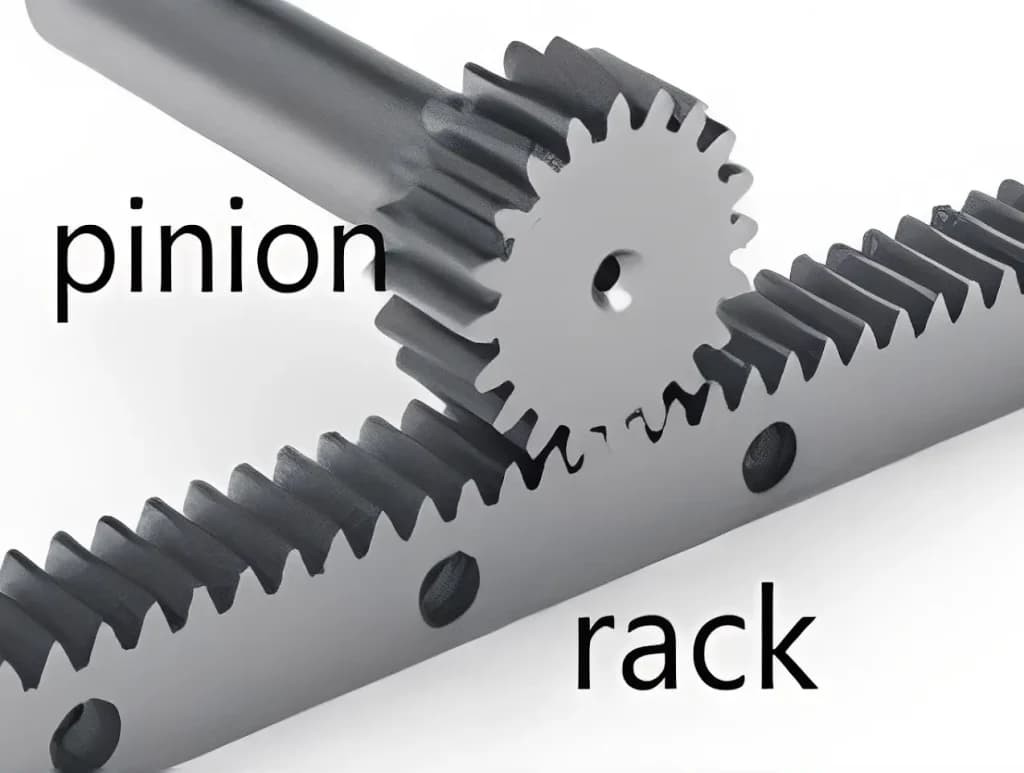
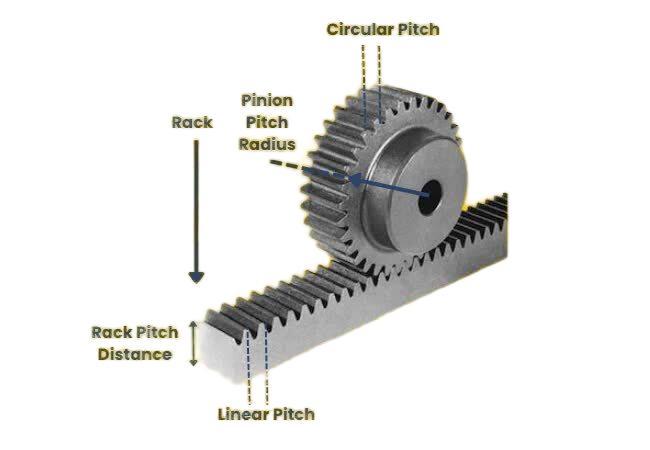
Rack and pinion gears are a gear pair in which a round pinion gear meshes with a straight toothed rack to convert rotary motion into linear motion.
Why rack and pinion gears matter in EV steering systems
The rack and pinion interface directly affects how steering input becomes rack travel. If the mesh has excessive clearance, uneven contact, high friction, or poor alignment, the steering system may show looseness, noise, uneven movement, or faster wear.
For EV applications, this becomes more sensitive because the whole vehicle is often quieter than traditional powertrain layouts. Small mechanical noise, roughness, or friction changes can be easier to notice. A rough tooth surface, unstable backlash, or poorly supported rack may not look serious during a basic dimensional check, but it can become obvious after assembly.
This is why rack and pinion gears in EV steering systems should be evaluated through full interface logic: gear tooth geometry, rack pitch, pinion runout, backlash, lubrication, support rigidity, surface quality, and contact consistency. The goal is not only to make a rack or a pinion. The goal is to make sure the pair moves smoothly, assembles repeatably, and remains stable across batches.
Common rack and pinion gear forms
| Rack and pinion form | Main feature | Best fit | What to watch |
| Simple tooth geometry with direct engagement | Basic steering-related layouts and compact linear motion | Backlash, tooth contact, and pitch consistency must be controlled | |
Helical rack with helical pinion | Angled teeth support smoother engagement | Applications that need lower noise and smoother motion | Axial force, alignment, and support stiffness need more attention |
Ground rack and pinion set | Higher tooth accuracy and surface quality | Precision movement or tighter response requirements | Higher cost and stricter inspection are usually required |
| Matched rack and pinion pair | Rack and pinion checked as a working set | Projects sensitive to feel, noise, backlash, and repeatability | Pair traceability and assembly assumptions should be clear |
| Pinion shaft with rack | Pinion gear integrated with a shaft or mounting interface | Compact mechanisms where datum control is critical | Runout, bearing seats, and shaft-related features must be inspected together |
A practical rule is simple
If the application only needs basic rotary-to-linear conversion, a straight rack and pinion may be enough. If the system is more sensitive to smoothness, noise, steering feel, and repeatable movement, geometry quality and pair inspection become more important.
The choice is not only between straight and helical teeth. Buyers should also ask whether the rack and pinion are expected to be supplied as a matched pair, whether the pinion is part of a shaft, and whether the assembly has enough stiffness to keep tooth contact stable under load.
Who should care about rack and pinion gear quality?
● EV steering system engineers: They need stable rack travel, controlled friction, and predictable movement under different steering loads.
● EV drivetrain and motion-system teams: Rack and pinion principles are useful in compact rotary-to-linear motion mechanisms beyond steering-related layouts.
● Procurement teams: They need to confirm material, heat treatment, tooth geometry, inspection scope, and whether the rack and pinion should be supplied as a matched set.
● Quality engineers: They need to check backlash, runout, tooth contact, pitch consistency, and assembly-related datum control.
● Replacement-part buyers: They need to avoid selecting parts that look similar but do not match the actual tooth system, pitch, pressure angle, or mounting assumptions.
Key design and production checks
| Check item | What to confirm | Why it matters |
| Tooth geometry | Module/DP, pressure angle, rack pitch, and tooth form | Ensures correct meshing and motion conversion |
| Backlash | Clearance between rack and pinion teeth | Too small increases friction; too large creates looseness |
| Pinion runout | Relation between teeth and shaft or mounting datums | Prevents uneven contact and steering variation |
Rack straightness | Linear accuracy of the rack body and tooth line | Supports smooth rack travel |
Surface finish | Tooth flank finish and roughness | Affects friction, noise, and wear |
Material and heat treatment | Surface hardness and core toughness | Balances wear resistance and impact tolerance |
Lubrication | Grease/oil condition and contamination control | Helps reduce wear and friction |
Pair inspection | Contact, backlash, movement feel, and consistency | Reduces assembly surprises |
Checking rack length, pinion diameter, or tooth count alone is not enough, because rack and pinion gears must be evaluated as a working pair, with pitch stability, backlash, surface finish, concentricity, and straightness all tied to real assembly performance.
Benefits of a well-controlled rack and pinion interface
| Benefit | What improves | Practical result |
| More stable steering movement | Rotary input converts into linear rack travel more consistently | Better movement repeatability |
| Lower friction | Tooth finish, lubrication, and support are controlled | Smoother operation |
| Better noise control | Backlash and contact remain stable | Less mechanical sound |
Longer service life | Load distribution and surface quality are improved | Lower wear risk |
Easier assembly | Datums and backlash targets are defined early | Fewer adjustments and less rework |
Better batch consistency | Inspection checks match real function | More stable repeat production |
In EV steering systems, these benefits matter because the rack and pinion interface affects both movement quality and long-term reliability. A small gear error can become a larger system-level issue after assembly. Stable geometry, controlled backlash, and consistent surface quality help reduce that risk before production scales.
From a sourcing point of view, a well-controlled rack and pinion pair also makes approval easier. The buyer and supplier can agree on the same inspection items, the same functional checks, and the same acceptance logic before samples are made.
Supplier selection tips for rack and pinion projects
● Start with function, not only dimensions. Tell the supplier whether the rack and pinion are used for steering movement, actuator motion, or another rotary-to-linear mechanism.
● Define backlash requirements early. Backlash directly affects looseness, friction, noise, and movement response.
● Ask how the rack and pinion will be inspected as a pair. Tooth geometry, pitch, runout, contact, and movement smoothness should be reviewed together.
● Confirm material and heat-treatment logic. The pinion often sees repeated load cycles and needs a balance of wear resistance and core toughness.
● Review assembly assumptions before sampling. Mounting datums, rack guides, bearing support, lubrication, and housing rigidity all affect final movement quality.
Why Choose Us
PairGears supports custom precision gear development for EV transmission and motion systems, treating rack and pinion gears as a working interface rather than separate parts. For EV applications, the focus is on stable movement, repeatable assembly, and consistent batch quality, which depends on practical control of geometry, material, process route, and inspection logic before production begins.
We focus on:
● tooth geometry review for rack and pinion engagement
● backlash and contact control for smoother movement
● material and heat-treatment matching to duty cycle
● inspection planning tied to function, not only nominal dimensions
● support from drawing review through repeat production
FAQ
Q1: What Does The Pinion Do In A Rack And Pinion System?
The pinion rotates and meshes with the straight rack, converting rotary motion into linear rack movement.
Q2: Why Is Backlash Important In Rack And Pinion Gears?
Backlash affects looseness, friction, noise, and movement response. It must be controlled according to the application.
Q3: Are Rack And Pinion Gears Always Supplied As A Matched Set?
Not always, but matched inspection is recommended when movement smoothness, noise, or assembly consistency is important.
Q4: What Causes Noise In Rack And Pinion Gears?
Common causes include excessive backlash, poor tooth contact, rough surface finish, runout, poor lubrication, or unstable rack support.
Q5: What Information Should I Provide For An RFQ?
Share drawings, module/DP, pressure angle, material, heat-treatment target, rack stroke, load condition, backlash requirement, and assembly assumptions.
Conclusion
Rack and pinion gears are a simple motion-conversion concept, but in EV steering systems they require careful control of geometry, backlash, friction, material, lubrication, and assembly conditions. A gear pair that only looks correct dimensionally may still create noise, looseness, uneven movement, or early wear if the working interface is not properly reviewed.
If you are preparing an RFQ, developing an EV-related rack and pinion mechanism, or troubleshooting gear noise, friction, backlash, or wear, you are welcome to Contact Us with your drawings, gear data, movement requirements, and operating conditions. PairGears can help review the rack and pinion interface and align it with a practical manufacturing and inspection plan.