How to Choose Reliable Bevel Gear Suppliers
Choosing a bevel gear supplier is rarely just a price decision. Two quotations may look similar while covering very different materials, heat-treatment routes, inspection items, tooling costs, and delivery responsibilities.
Before placing an order, buyers should confirm whether the supplier understands the gear type, application, drawing requirements, and quality records that the project actually needs. This guide focuses on the practical checks that help reduce sourcing risk without turning the supplier review into an unnecessarily long process.
Understanding Bevel Gear Types and Their Applications
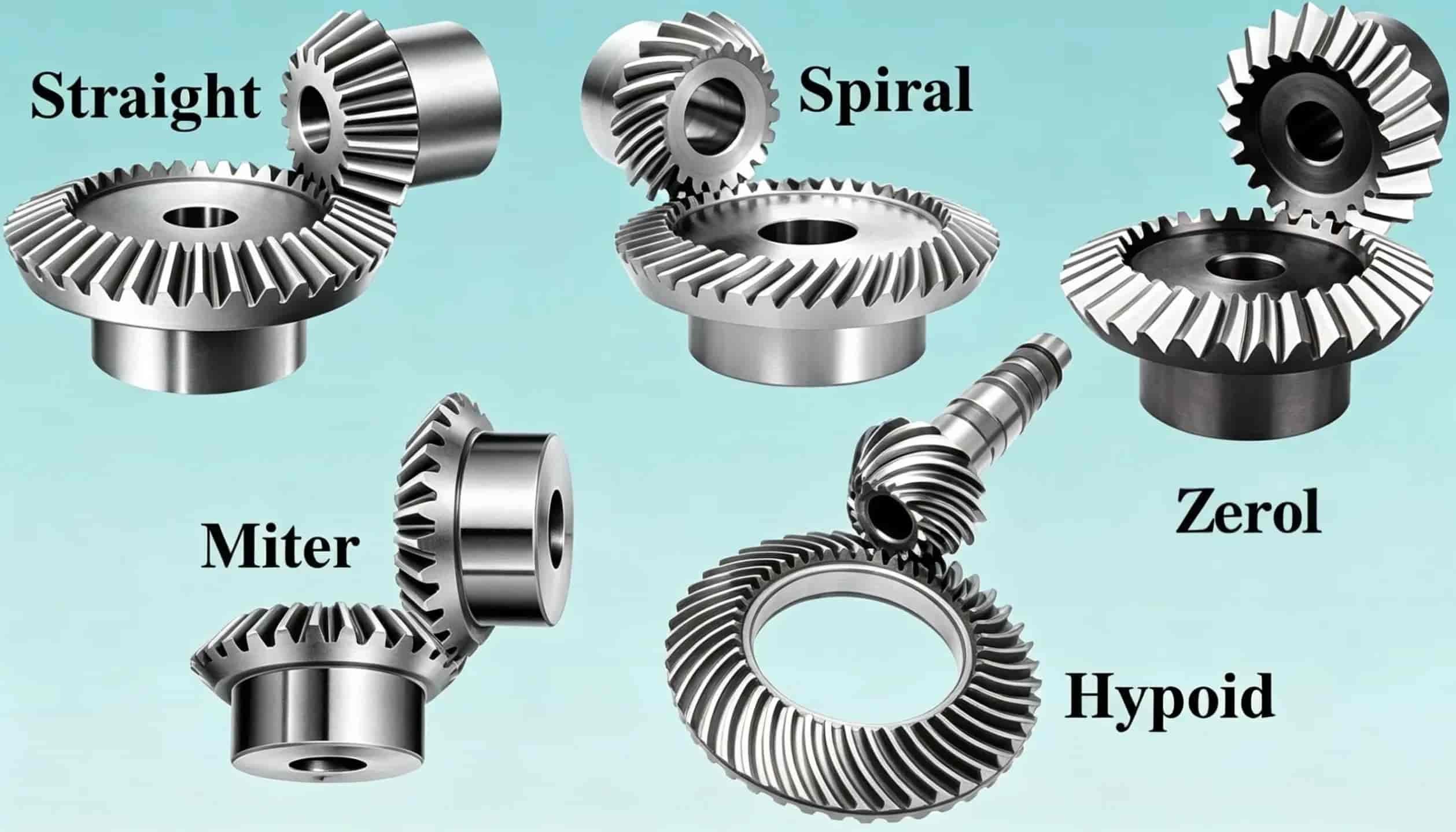
Bevel gears transmit motion between shafts set at an angle, commonly 90 degrees. Before comparing suppliers, confirm the gear type and how its geometry will be verified.
Straight Bevel Gears
Straight teeth are comparatively simple to manufacture and inspect. They are common in agricultural machinery, hand tools, and moderate-speed right-angle drives where durability and cost matter more than minimum noise.
Spiral Bevel Gears
Curved teeth engage gradually, improving load sharing and usually giving smoother operation. They require controlled geometry, matched assembly, dedicated tooling, and suitable cutting, grinding, or lapping capability.
Hypoid Gears
Hypoid gears use offset, non-intersecting axes. The offset supports compact, high-torque layouts but increases tooth sliding, making lubrication, surface finish, contact pattern, and heat treatment especially important.
Straight Bevel Gears vs Spiral Bevel Gears: Making the Right Choice
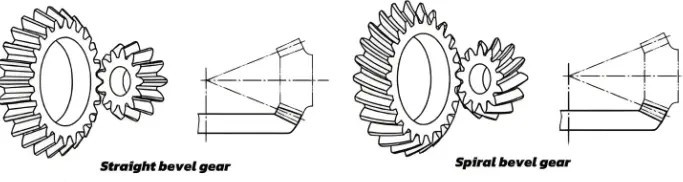
The choice depends on speed, torque, noise, installation space, service conditions, and budget. Use the table as an RFQ starting point, then confirm the actual duty.
| Factor | Straight Bevel Gear | Spiral Bevel Gear |
|---|---|---|
| Tooth engagement | More abrupt | Gradual and overlapping |
| Typical duty | Low to moderate speed and load | Moderate to high speed or load |
| Noise | Usually higher | Usually lower when properly designed and aligned |
| Manufacturing | Simpler tooling and process route | More specialized tooling, processing, and inspection |
| Common uses | Agricultural drives, tools, simple right-angle units | Axles, industrial drives, EV and heavy-equipment systems |
Whichever type is selected, the drawing should state the accuracy standard, backlash, contact-pattern requirement, runout, material, heat treatment, and inspection scope. Leaving these points open can lead two suppliers to quote technically different parts under the same part number.
Material Selection and Heat Treatment: The Foundation of Gear Performance
Material choice should reflect tooth load, impact, expected life, temperature, lubrication, and cost. The heat-treatment route must also suit the part size and the distortion that later finishing can correct.
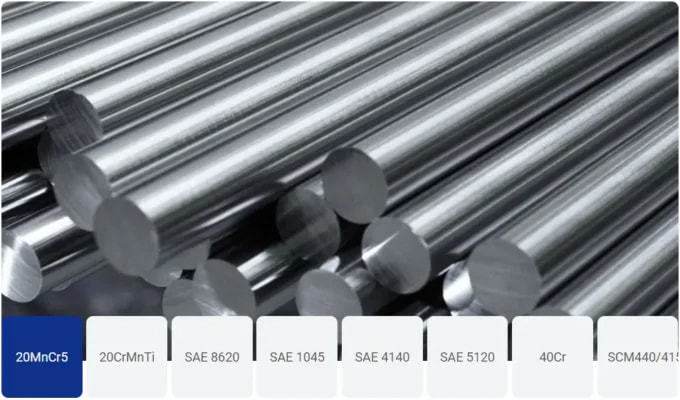
Common Material Routes
Grades such as 20CrMnTi, 8620, and 9310 can provide a hard surface with a tougher core. Selection should reflect case depth, core strength, hardenability, and the applicable material standard.
40Cr, 4140, and 1045 may be used with quench-and-temper or induction hardening. The route depends on section size, hardness pattern, root coverage, distortion risk, and service load.
Carburizing and Quenching
This route is widely used when high surface hardness and core toughness are both required. Case depth, surface hardness, core hardness, and allowable distortion should be stated on the drawing or process specification and checked using an agreed sampling method.
Induction Hardening
Induction hardening treats selected tooth areas and can suit medium- or large-module gears. Buyers should review the hardened pattern and root coverage instead of checking only a single surface-hardness value.
Quality Standards and Inspection: What Buyers Should Confirm
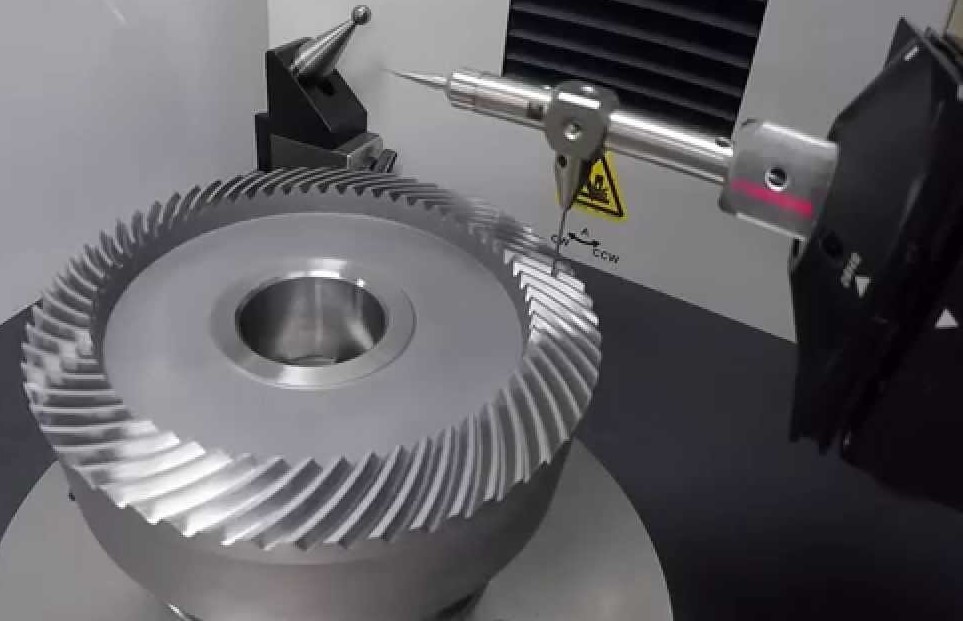
Bevel gear accuracy should be stated using a suitable standard, such as ISO 17485, or another standard agreed on the drawing. ISO 17485 uses grades 2 to 11, with lower numbers indicating tighter geometrical tolerances. The required grade should come from the application and design review, not from a supplier's marketing claim.
| Item | What the Buyer Should Confirm |
|---|---|
| Accuracy standard | Standard, grade, measurement method, and acceptance criteria |
| Contact pattern | Required location, size, and evidence for the matched set |
| Backlash and runout | Limits, assembly condition, and inspection position |
| Heat treatment | Surface hardness, core hardness, case depth, and sampling plan |
| Shipment records | First-article, dimensional, material, and heat-treatment documents |
ISO 9001 gives a general quality-management baseline. IATF 16949 may be required for automotive programs. CMM and gear-measurement reports are inspection records, so ask what was measured, on which equipment, and against which limits.
How to Evaluate Bevel Gear Suppliers: 5 Practical Checks
Focus the supplier review on what the company can control and prove. These checks help compare quotations on the same technical basis.
Confirm the Actual Process Capability
Ask about the relevant gear type, size range, processing method, tooling, and inspection equipment. Confirm which operations are subcontracted and how outside processes are approved and checked.
Review Material and Heat-Treatment Control
Check material traceability, approved sources, heat-treatment specifications, and distortion control. Outsourcing is acceptable when the gear supplier controls the process, verifies the results, and manages corrective action.
Ask for a Sample Inspection Report
A useful report shows the measured characteristics, equipment, drawing limits, actual results, and part identification. Matched sets may also need contact-pattern or pairing records. A generic pass certificate is not enough.
Look for Specific Engineering Feedback
A capable supplier should identify missing data, impractical tolerances, heat-treatment risks, datum questions, and assembly concerns before production. Useful DFM feedback refers to the actual drawing.
Compare the Complete Commercial Scope
Unit price can hide differences in tooling, sample approval, inspection, packaging, Incoterms, and documents. Ask the supplier to state the lead-time assumptions and commercial scope clearly in the quotation.
When two quotations differ sharply, ask each supplier to mark what is included and excluded. Tooling ownership, trial-piece approval, destructive testing, gear-pair inspection, export packaging, and report fees can change the final cost. A slightly higher quotation may cover work that would otherwise appear later as an additional charge.
Why PairGears: Precision Bevel Gear Manufacturing You Can Rely On
PairGears supplies custom gears and shafts for agricultural machinery, heavy trucks, construction equipment, and electric vehicles. The team reviews the drawing, application, quantity, and inspection scope before confirming the manufacturing route.
Frequently Asked Questions About Bevel Gear Suppliers
What information is needed for a bevel gear quotation?
Provide a drawing or 3D model, gear data, material, heat treatment, accuracy requirement, backlash, quantity, and operating conditions such as torque, speed, duty cycle, temperature, and lubricant. For a replacement project, add sample photos, mating-part information, and any available failure details.
Can a supplier quote a bevel gear without a drawing?
A preliminary review may be possible from an unworn sample, clear photographs, an OEM number, or basic gear data. However, a final production quotation usually requires enough information to confirm geometry, material, tolerances, heat treatment, and inspection. A worn sample may not represent the original dimensions, so reverse engineering often requires extra checks.
What is the typical MOQ and lead time?
Sample and trial quantities are reviewed case by case. Under current regular production conditions, the typical production MOQ is about 200 pieces. Suitable samples may take around 15 days, while regular production is generally planned at 45–60 days. Tooling, material, heat treatment, quantity, and inspection can change the final schedule.
Should spiral bevel gears be ordered as matched sets?
In many applications, the pinion and gear are checked and supplied as a matched pair because tooth contact and backlash depend on both members and the assembly position. Replacing only one member can produce an unsuitable contact pattern. The supplier should review the original design, mating gear condition, and installation requirements before confirming the replacement scope.
Which inspection documents should buyers request?
The answer depends on project risk. Common documents include a material certificate, dimensional report, hardness record, case-depth report, contact-pattern evidence, and first-article report. List the required records in the RFQ and purchase order so the supplier can include the inspection work in its quotation.
Making the Right Choice for Your Next Bevel Gear Project
A reliable bevel gear supplier should be able to explain how the drawing will be manufactured, heat-treated, inspected, documented, and delivered. Clear answers during the RFQ stage often prevent more problems than a low initial price can solve.
Send PairGears your drawing, sample information, and expected quantity for a manufacturing review. You can request a quotation or contact our team to discuss the technical requirements.