How To Choose Between Internal And External Gears
Choosing between internal gears and external gears is an important decision in custom gear projects because the gear structure affects equipment size, transmission performance, load capacity and manufacturing requirements. There is no single gear type that is suitable for every application. The right choice depends on factors such as available space, operating conditions, accuracy requirements and production feasibility.
As a precision gear manufacturer, PairGears supports custom gear projects for different industries, helping customers evaluate gear structures, materials, manufacturing processes and inspection requirements based on their applications. For engineers and buyers sourcing custom gears, understanding the differences between internal and external gears can help avoid design changes and improve communication with suppliers. This article explains how these two gear types work, where they are commonly used, and what factors should be considered when selecting the right solution.
Internal And External Gears At A Glance
Internal and external gears are selected based on different application requirements, including equipment structure, available space, transmission needs and manufacturing conditions.
Internal Gears
Internal gears are commonly used when compact design, coaxial transmission and high integration are required, such as planetary gear systems.
External Gears
External gears are more widely used in industrial transmission systems because of their flexible design and mature manufacturing processes.
When selecting a gear type, buyers should consider factors such as load requirements, operating speed, accuracy level, installation method and working environment instead of focusing on the gear type alone.
What Are Internal And External Gears?
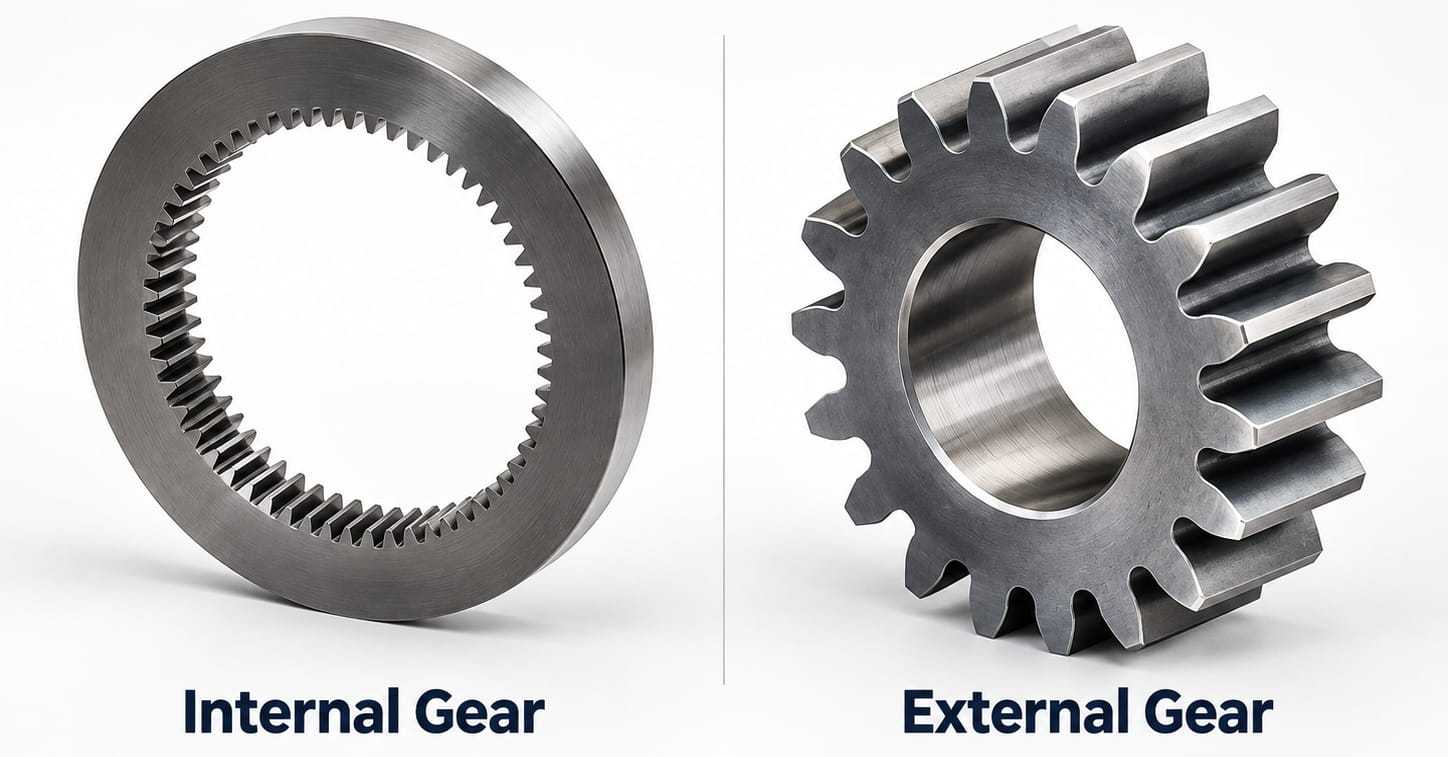
Based on the position of the teeth, gears can generally be divided into internal gears and external gears.
External Gears
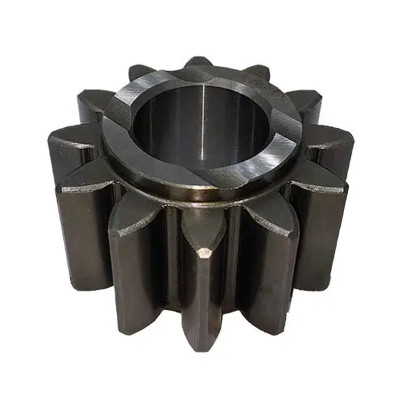
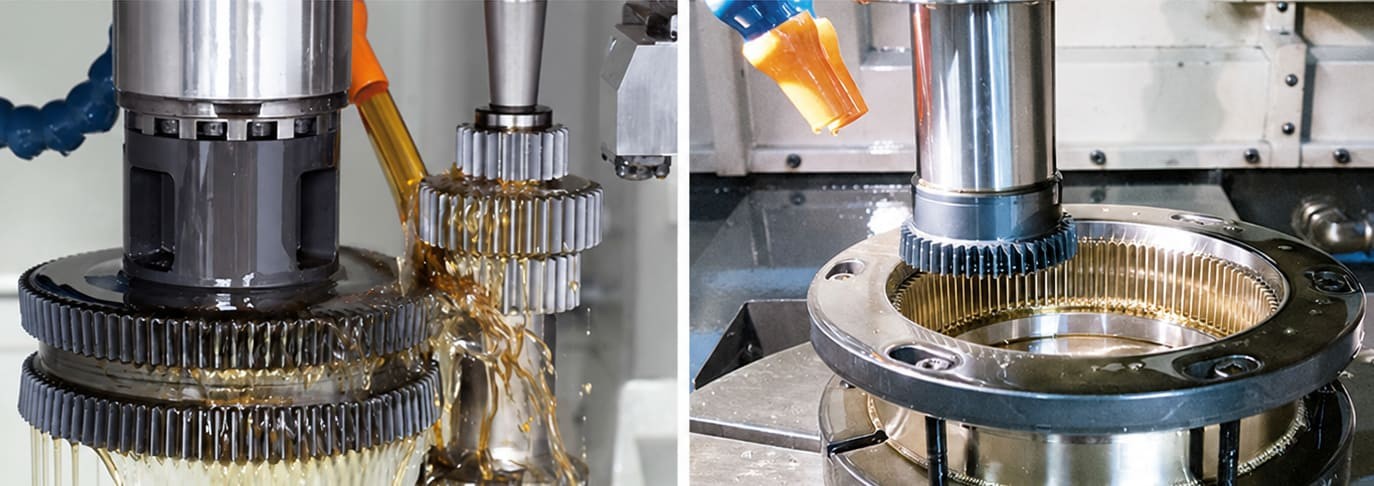
External gears are the most common type of gears, with teeth machined on the outer surface of the gear. When two external gears mesh together, they rotate in opposite directions.
Common external gear types include:
• Spur gears
• Helical gears
• Bevel gears
Internal Gears
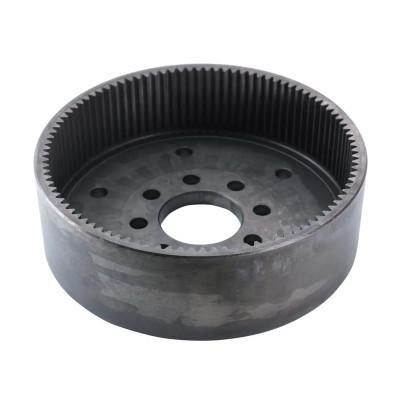
Internal gears have teeth machined on the inner diameter of the gear ring and usually mesh with an external pinion or sun gear.
Internal gears are commonly found in:
• Planetary gear systems
• Robotics
• Automation equipment
• Compact transmission systems
Key Factors When Choosing Internal Or External Gears
Equipment Space
Internal gears allow multiple gears to be arranged on the same axis, making them suitable for applications where installation space is limited.
Key advantages include:
• Compact structure
• Coaxial input and output arrangement
• Efficient use of space
External gears generally provide more flexibility in mechanical design.
Advantages include:
• Simple structure
• Flexible installation options
• Easier maintenance and replacement
Consider Your Transmission Requirements
Gear selection should also consider transmission performance requirements.
When a system requires a high reduction ratio while maintaining a compact size, internal gear arrangements are often considered.
External gear systems provide more flexibility in gear arrangement and can be designed for different shaft distances and transmission layouts.
Load And Torque Requirements
Load capacity depends on multiple factors, including:
• Gear size
• Material selection
• Face width
• Heat treatment
• Tooth contact conditions
It is not accurate to assume that one gear type always provides higher load capacity than another.
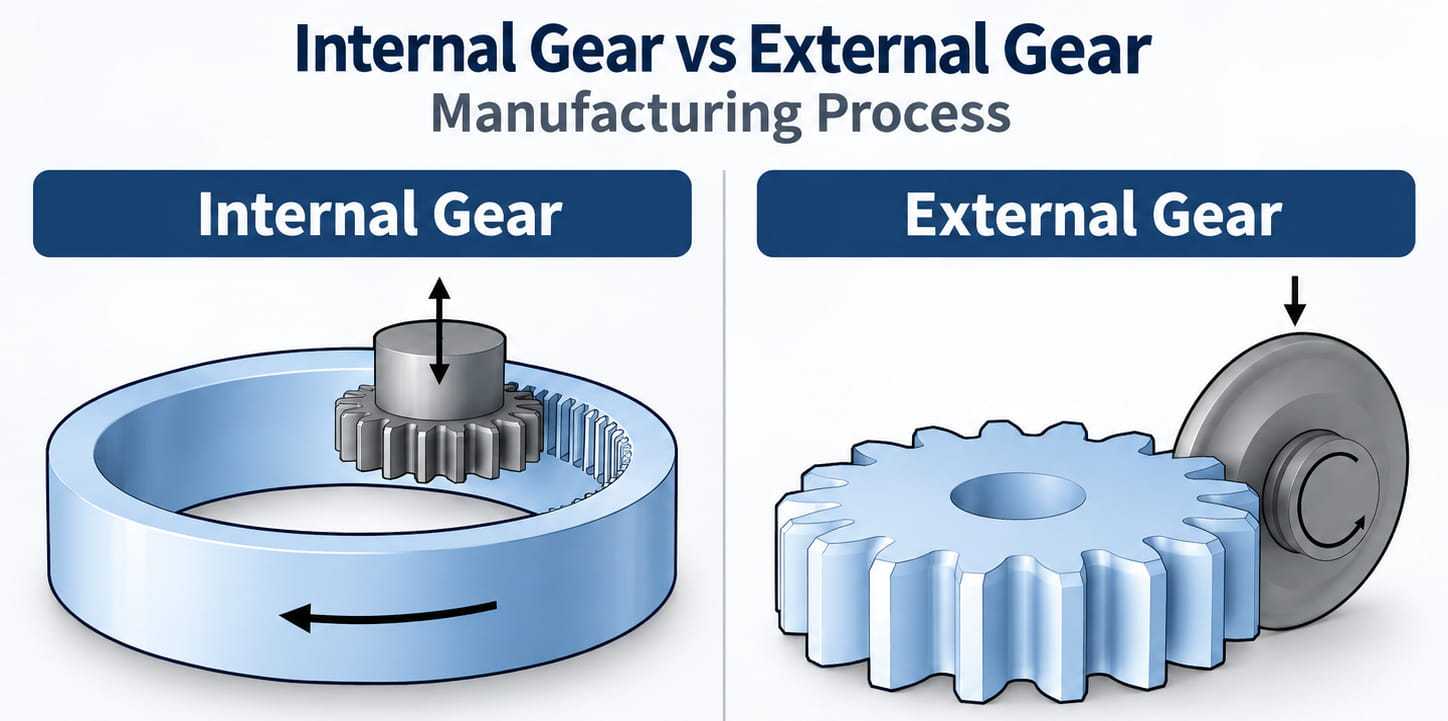
Manufacturing Process Should Be Considered
| Gear Type | Common Processes | Key Considerations |
|---|---|---|
| External Gear Manufacturing | Hobbing Gear shaping Gear grinding |
Common for industrial gears, standard transmission components and custom mechanical parts. |
| Internal Gear Manufacturing | Gear shaping Broaching Internal grinding |
Requires attention to tooth profile accuracy, concentricity, gear matching conditions and meshing performance. |
Match The Gear Type With Application
Different applications often require different gear structures.
| Application | Common Choice | Reason |
|---|---|---|
| Planetary gearbox | Internal gears | Compact structure and high reduction ratio |
| Industrial gearbox | External gears | Flexible design and wide application |
| Robotics systems | Internal gears | Space saving and precise transmission |
| Agricultural machinery | External gears | Reliable power transmission |
| Automation equipment | Internal or external gears | Depends on system design |
In real projects, there is no single gear type suitable for every application. The correct choice depends on the complete system requirements.
What Should Buyers Confirm Before Ordering Custom Gears?
When sourcing custom internal or external gears, buyers should prepare the following information whenever possible:
| Information | Why It Matters |
|---|---|
| Gear drawing or 3D model | Confirm gear geometry |
| Gear type | Select suitable manufacturing process |
| Module or DP | Define tooth size |
| Number of teeth | Determine transmission ratio |
| Material requirement | Evaluate strength and durability |
| Heat treatment | Define performance requirements |
| Accuracy requirement | Control transmission performance |
| Application condition | Understand working environment |
If complete drawings are not available, buyers can also provide existing gear samples, OEM numbers, product photos or key dimensional information.
How PairGears Supports Custom Internal And External Gear Projects
For custom gear projects, PairGears works with customer drawings, samples and application requirements to help confirm:
• Gear structure design
• Material selection
• Manufacturing process
• Heat treatment options
• Accuracy requirements
• Inspection standards
From prototype development and sample validation to repeat production and volume production, PairGears manages the manufacturing process to help customers achieve reliable and consistent gear solutions.
FAQ About Internal And External Gears
What Is The Main Difference Between Internal And External Gears?
The main difference is the location of the teeth. Internal gears have teeth on the inside diameter of the gear ring, while external gears have teeth on the outside diameter.
Are Internal Gears Better Than External Gears?
Not always. Internal and external gears are designed for different applications. Internal gears are often suitable for compact transmission systems, while external gears are widely used for general power transmission applications.
Where Are Internal Gears Commonly Used?
Internal gears are commonly used in planetary gearboxes, robotics, automation equipment and other systems that require compact transmission structures.
Why Are Internal Gears More Difficult To Manufacture?
Internal gears usually require specialized manufacturing processes because the teeth are located inside the gear ring. Maintaining tooth accuracy, concentricity and proper meshing requires careful process control.
What Information Is Needed For Custom Internal Or External Gears?
Buyers should provide gear drawings, 3D models, tooth information, material requirements, heat treatment specifications, accuracy requirements and application details whenever possible.
Conclusion
Choosing between internal and external gears requires a complete understanding of the equipment design and transmission requirements. Internal gears are suitable for applications that require compact structures and high integration, while external gears remain a popular choice due to their flexible design and mature manufacturing process.
For custom gear projects, clearly defining the gear type, operating conditions, material, accuracy and manufacturing requirements helps suppliers develop a more suitable solution.