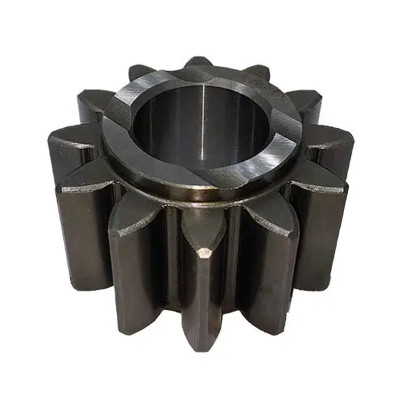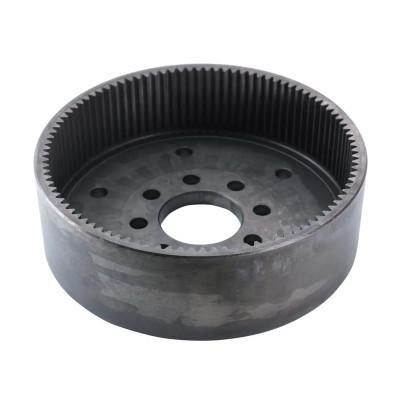
Ring Gear Types: How They Work and Where They Are Used
The term ring gear appears frequently on gear drawings, parts catalogs, and transmission assemblies, but it does not always describe the same type of gear. In a planetary gearbox, a ring gear usually has internal teeth and works with the sun and planet gears. In an automotive differential, the ring gear may be a bevel or hypoid gear paired with a drive pinion. Similar names are also used for gears fitted to engine flywheels and large slewing mechanisms.
For this reason, describing a component simply as a “ring gear” is rarely enough for a custom project. At PairGears, the transmission arrangement, mating gear, tooth geometry, material, heat treatment, mounting condition, and final accuracy all need to be considered before the manufacturing and inspection route can be defined.
What Does Ring Gear Mean?
A ring gear is a ring-shaped gear used to transmit torque, but it does not refer to a single tooth form. Depending on the application, it may use internal, external, bevel, or hypoid teeth.
This makes “ring gear” different from terms such as spur gear or helical gear, which directly describe tooth geometry. Ring gear is often a structural or application-based name instead. When the term appears on a drawing or RFQ, the first question should therefore be what type of transmission the gear belongs to.
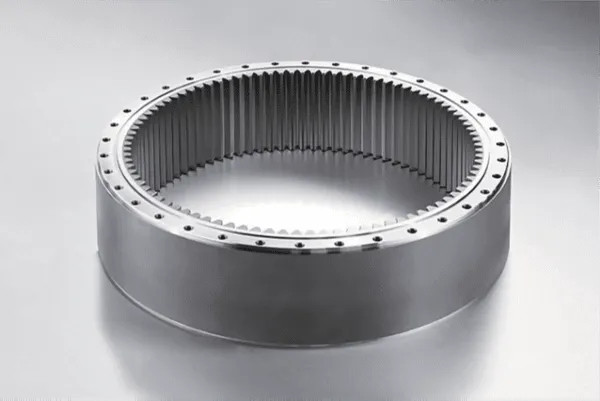
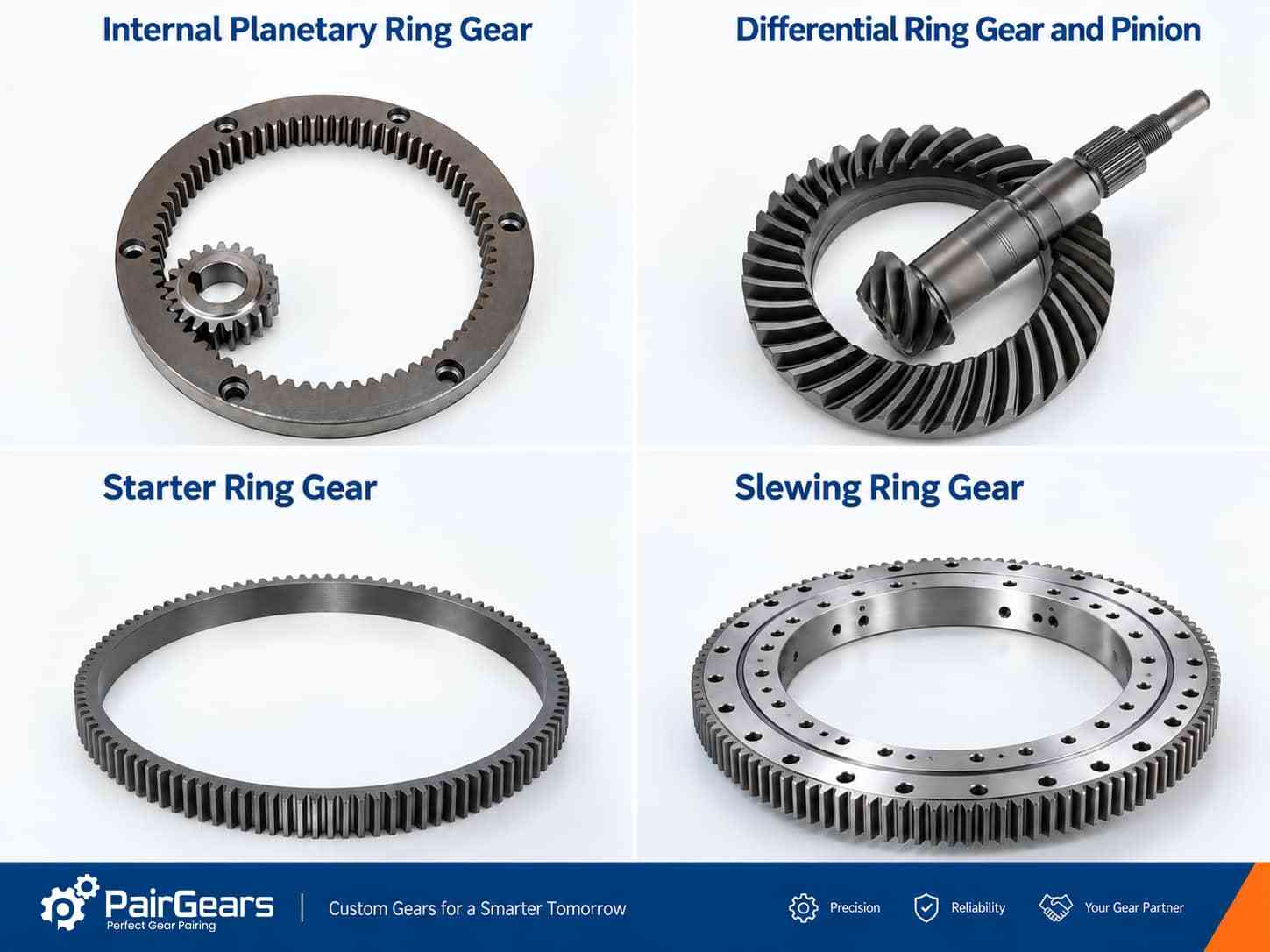
The four common categories discussed here are internal ring gears, differential ring gears, starter ring gears, and slewing ring gears.
What Are the Main Types of Ring Gears?
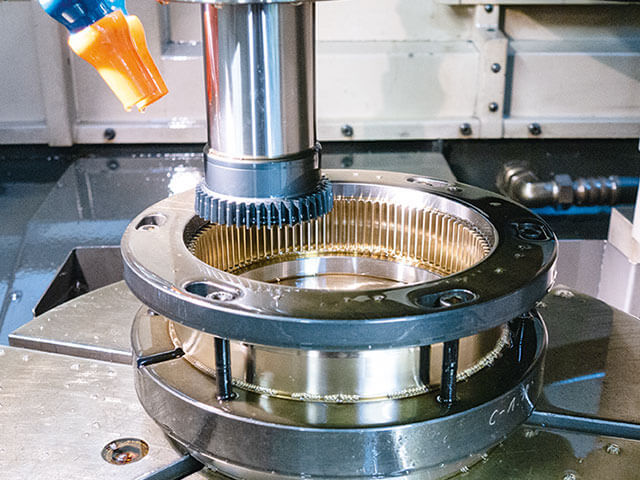
An internal ring gear has teeth on the inside diameter and is also commonly called an annulus gear. It is most often used in planetary gear systems, where the planet gears mesh with both the central sun gear and the surrounding ring gear.
Depending on which member is fixed, driven, or used as the output, the planetary system can provide different speed ratios and directions of rotation. The ring gear is therefore an active transmission component rather than simply an outer housing. Its geometry, tooth accuracy, and relationship with the planet gears directly affect how the system operates. Manufacturing internal gears also requires attention to cutter access, interference, and the available space inside the ring.
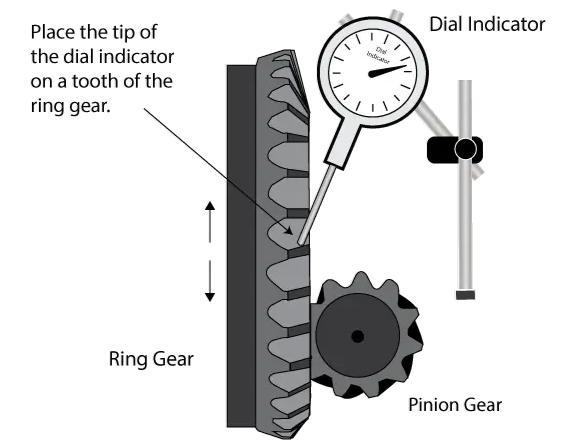
A differential ring gear is commonly used in cars, trucks, and some construction or off-highway equipment. Unlike a planetary internal ring gear, it normally works with a smaller bevel or hypoid drive pinion. The pinion transfers input torque to the larger ring gear, which then drives the differential assembly.
In this type of system, the mating relationship between the two gears is especially important. Tooth geometry, backlash, mounting position, and contact pattern all affect how the pair runs. A differential ring gear should therefore not be evaluated only by outside diameter, tooth count, or material. The mating pinion gear and installation conditions may be equally important.
A starter ring gear is normally fitted around the outside of an engine flywheel or flexplate. During startup, the starter motor pinion engages the ring gear and rotates the flywheel, which turns the crankshaft until the engine starts running.
Unlike gears that remain in continuous mesh, starter ring gears operate intermittently. Each engagement is short, but the teeth can experience impact and concentrated loading. Tooth geometry, hardness, runout, and correct engagement with the starter pinion therefore matter. In service, wear may also become concentrated in certain areas rather than appearing evenly around the entire circumference.
Slewing ring gears are widely used in excavators, cranes, aerial platforms, and other equipment that needs to rotate a large structure. A relatively small drive pinion meshes with the large ring gear to generate slewing motion. Depending on the machine design, the teeth may be located on either the outside or inside diameter.
These gears are often large in diameter and operate at relatively low rotational speed, but they may transmit substantial torque. This makes mounting accuracy, radial runout, concentricity, and backlash around the circumference important considerations. Even if individual tooth geometry is acceptable, poor mounting or excessive runout can still cause the working backlash to vary as the gear rotates.
How Do Different Ring Gears Work?
Although these parts share the same general name, their mating components and operating functions differ considerably.
| Ring Gear Type | Typical Mating Part | Main Function | Typical Application |
|---|---|---|---|
| Internal ring gear | Planet gears | Forms part of a planetary transmission | Planetary gearbox |
| Differential ring gear | Bevel / hypoid pinion | Transfers torque and changes drive direction | Axle, differential |
| Starter ring gear | Starter pinion | Turns the engine during startup | Engine, vehicle |
| Slewing ring gear | Drive pinion | Rotates a large structure | Excavator, crane |
This is why the application and mating arrangement should be identified before selecting material, manufacturing process, or inspection requirements.
Is a Ring Gear the Same as an Internal Gear?
No. An internal ring gear is one type of ring gear, but not every ring gear is an internal gear.
Internal Ring Gear
Normally has teeth on the inside diameter and commonly works with planet gears in a planetary transmission.
Other Ring Gears
Differential ring gears may use bevel or hypoid teeth, starter ring gears usually have external teeth, and slewing ring gears may use either internal or external teeth.
This distinction is important when requesting a quotation. An RFQ that only says “ring gear” leaves too many technical questions unanswered. A description such as “internal ring gear for a planetary gearbox” or “hypoid ring gear matched with a drive pinion” gives a much clearer starting point and reduces the risk of assumptions during technical review.
How Are Ring Gears Manufactured?
There is no single manufacturing method for all ring gears because the tooth geometry and part structure can vary significantly.
Internal Ring Gears
May be produced by gear shaping, gear skiving, or other suitable internal cutting methods. Since the cutting tool must work inside the ring, inside diameter, face width, nearby shoulders, and tool clearance can all affect process selection.
Differential Ring Gears
Bevel or hypoid geometry requires the corresponding bevel gear cutting route and may also involve heat treatment, lapping, grinding, or contact pattern inspection depending on the drawing and application.
Starter Ring Gears
May use external tooth cutting together with heat treatment, hardness control, runout inspection, and engagement-related checks according to the application.
Slewing Ring Gears
May require different combinations of tooth cutting, heat treatment, datum control, large-diameter handling, and runout inspection depending on whether the teeth are internal or external.
Two components with the same “ring gear” name can therefore require very different machines, tooling, heat-treatment routes, and inspection methods.
What Should Buyers Check Before Ordering a Ring Gear?
Before requesting a quotation, buyers should provide enough information to show not only what the ring gear looks like, but also how it works in the assembly. This allows the manufacturing route to be based on actual operating requirements rather than assumptions.
| Item to Confirm | Why It Matters |
|---|---|
| Gear type | Identifies whether it is internal, differential, starter, slewing, or another design |
| Tooth data | Defines module/DP, tooth count, pressure angle, helix angle, and tooth geometry |
| Mating gear | Helps determine backlash, mounting relationship, and tooth contact |
| Material | Establishes the required base material |
| Heat treatment | Defines hardness, case depth, and finishing sequence where required |
| Accuracy | Determines tooth quality and critical tolerances |
| Mounting datums | Controls bore, face, concentricity, and runout relative to the teeth |
| Inspection | Confirms dimensional, tooth, hardness, or contact checks |
If formal quality documentation is needed, the required contents of the gear inspection report should ideally be agreed during quotation rather than requested only after production is complete.
Why Do Mounting and Runout Matter for Ring Gears?
Because many ring gears have a relatively large diameter compared with their tooth size, mounting errors can noticeably affect actual meshing. Bore concentricity, mounting-face accuracy, radial runout, and axial runout can all change the relationship between the ring gear and its mating component.
This is particularly relevant for slewing gears and differential applications. A gear may have acceptable tooth geometry when measured individually, but the installed assembly can still show uneven backlash if the mounting reference or runout is not properly controlled. Inspection should therefore consider not only the teeth themselves, but also their relationship with the functional mounting datums.
FAQ About Ring Gears
What is a ring gear?
A ring gear is a ring-shaped gear used in different types of transmission systems. Depending on the application, it may have internal, external, bevel, or hypoid tooth geometry.
Are all ring gears internal gears?
No. Planetary ring gears usually have internal teeth, but differential, starter, and some slewing ring gears do not.
What is an internal ring gear used for?
Internal ring gears are commonly used in planetary gear systems, where they mesh with planet gears around a central sun gear and form an active part of the transmission.
Should a ring gear and pinion be ordered together?
It depends on the application. For bevel or hypoid ring-and-pinion systems, information for both parts is useful because backlash, mounting position, and tooth contact need to be evaluated together.
What information is needed for a custom ring gear quote?
A custom ring gear quote normally requires the drawing, gear type, tooth data, mating gear information, material, heat treatment, production quantity, accuracy requirements, and inspection requirements.
Conclusion
Ring gears may look similar at first, but the application usually determines what really matters. A planetary internal ring gear, a differential ring gear, and a slewing ring gear can differ greatly in tooth geometry, mating conditions, loading, and mounting requirements. That is why the drawing should always be reviewed together with the mating parts and the actual assembly, rather than judging the gear by its name alone.
Need a Custom Ring Gear Manufacturing Review?
If you have a ring gear project under review, send your drawing along with the mating gear details, material, heat treatment, quantity, and required accuracy. We can use that information to review the machining route and inspection requirements before quotation.