Common Gear Types Used in Industrial Gearboxes
People tend to picture an industrial gearbox as a box full of one standard gear. Open one up and that picture falls apart pretty fast. Speed, torque, reduction ratio, how the shafts sit, how much noise the plant can stand — any one of these changes, and the gear changes with it.
For a buyer, “which gear is this?” is the easy question. The harder ones are why this gear was put in this gearbox, and what you actually have to confirm with a supplier before ordering a replacement or a custom part. We at PairGears don't quote custom work from a photo and an outline. We want the drawing, the worn part, the mating gear, and the real duty. Skip one of those and the “solution” has a fair chance of being wrong.
Which Gear Types Are Commonly Used in Industrial Gearboxes?
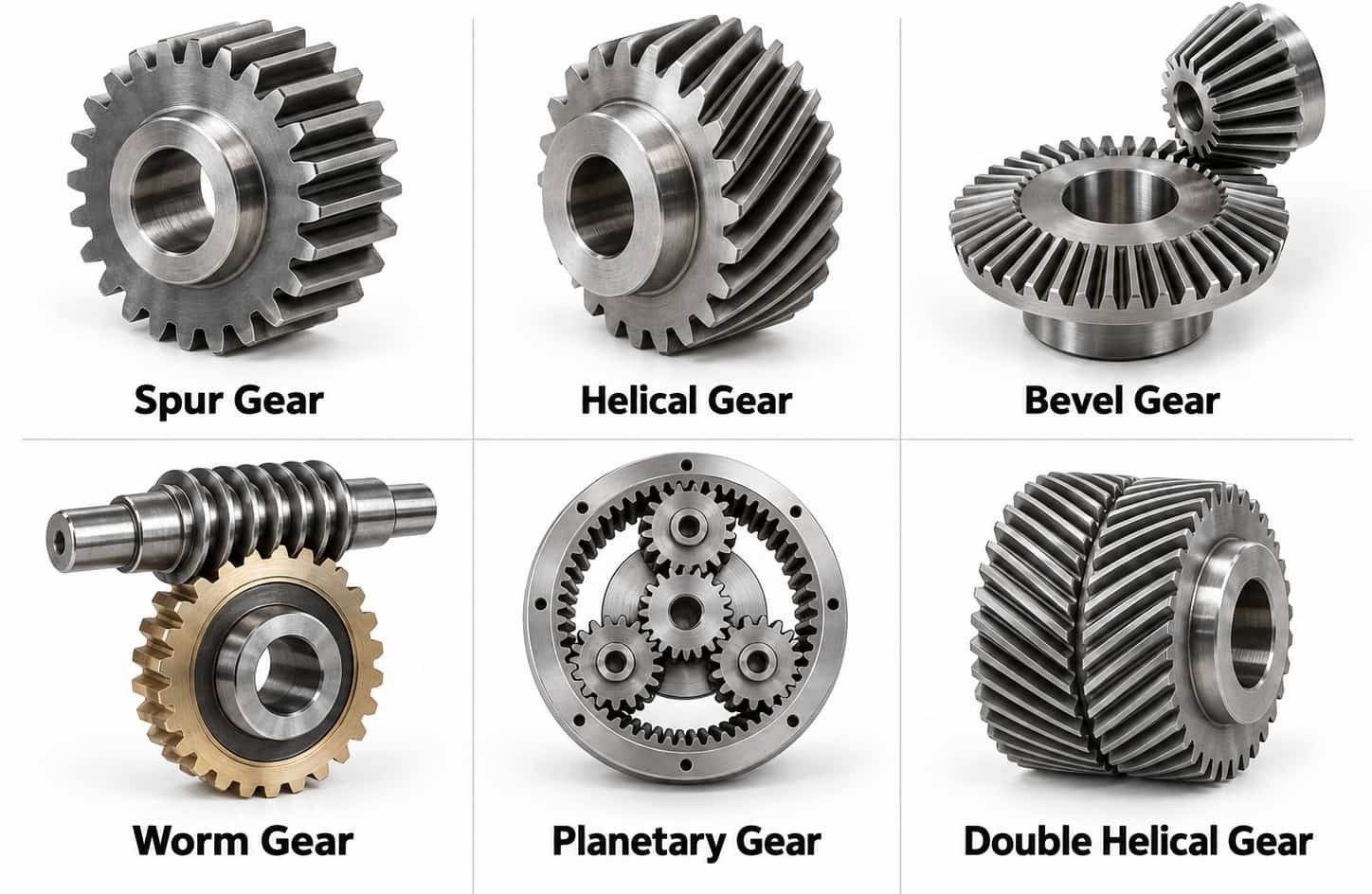
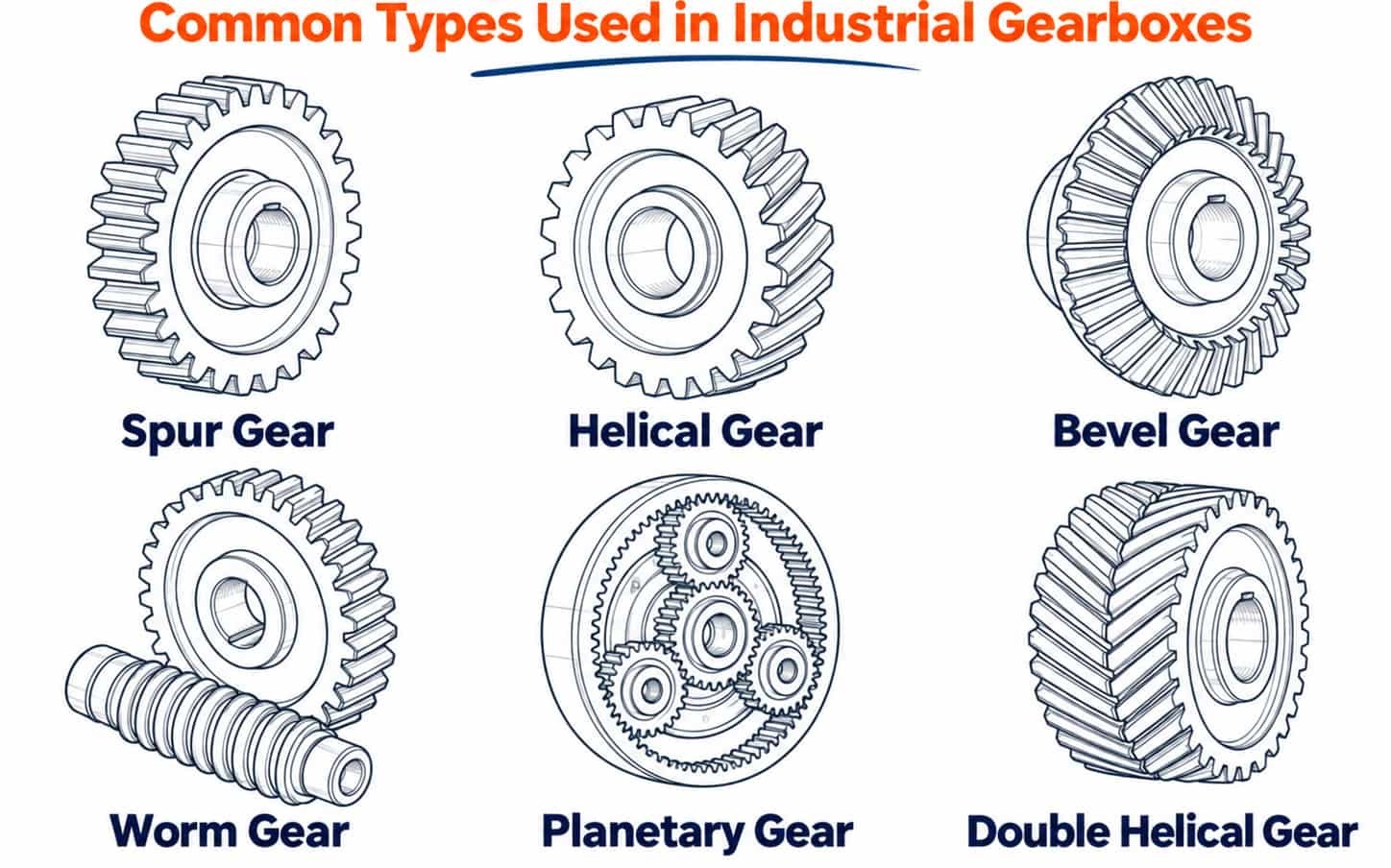
The gear types you'll actually find in industrial gearboxes come down to a short list: spur gears, helical gears, bevel gears, worm gears, and planetary gear sets. On heavier drives, double helical or herringbone gears show up too.
People ask us all the time which one is best. There's no best. It's matching — drive direction, load, speed, ratio, efficiency, space. Line those up and the type usually picks itself.
How the Main Gear Types Differ
Spur gears are the plain workhorse of the industry. Teeth run parallel to the shaft, the geometry is nothing exotic, and they're quick to cut and quick to check. Their usual job is straight power transfer between parallel shafts.
You'll see them where the drive is slow to medium, where the reduction is simple, and where keeping cost and maintenance low beats refinement.
The good part is they don't push axial load into the bearings, so installation is forgiving. The less good part shows up at speed: teeth bang in and out of mesh, and the noise and vibration are hard to miss. Gearbox has to run fast and quiet? You'll be looking at helical gears instead.
Helical gears are the most common type in industrial gearboxes, and it isn't close.
The tooth line is what separates them from spur gears. Helical teeth are angled to the axis, so they engage gradually. The tooth faces slide into contact a bit at a time. That gives you smoother running, and more teeth carrying the load at any one moment. Both of those matter.
So helical gears are the usual residents of industrial reducers, heavy machinery, conveyors, and just about any drive that runs day in, day out.
The catch is axial thrust. Helical mesh pushes sideways, and the bearings have to take that. Forget it in the design and you get bearing problems down the road — a classic, avoidable failure.
If you're ordering a replacement helical gear, tooth count and module are only the beginning. You also need the helix angle, the hand of helix, the normal pressure angle, and how the teeth pair with the mating gear. The hand is the one people get wrong most often, and you find out from the noise after installation.
Bevel gears are for one thing: changing the direction of power between intersecting shafts.
Two kinds turn up in industrial gearboxes, straight bevels and spiral bevels. Straight bevels are simpler to make. Spiral bevels engage more progressively, which is why they get picked for higher speeds or when smooth running counts.
Right-angle drives, industrial machinery, construction equipment, anywhere the power has to bend around a corner, you'll find a bevel pair.
Bevels are touchier about mounting and pairing than cylindrical gears, and that's the part buyers underestimate. Besides tooth count, module, and pressure angle, you're looking at mounting distance, shaft angle, contact pattern, and backlash. And you really want to treat the gear and pinion as one matched set, because checking one half alone won't tell you much. A contact pattern that's drifted to the toe or the heel is usually not one tooth's fault.
A worm set is a worm plus a worm wheel. Its whole reason for existing is a big reduction ratio in a small space. One worm stage will get you somewhere in the 5:1 to 60:1 range, which a single spur pair can't touch.
That's why you find them in lifting equipment, conveyors, actuators, and gearboxes that want low speed and a lot of ratio.
Worm mesh slides, though, and sliding is expensive. It costs efficiency, it demands proper lubrication, and it dictates material choice, which is also why you don't usually see the worm and wheel made of the same material. Sliding contact just won't allow it.
When buying a worm set, don't stop at tooth geometry. Ask for lead angle, center distance, material pairing, lubrication method, and the actual operating temperature. If efficiency matters, run the numbers before ordering. After installation is the wrong time to find out.
A planetary gearbox isn't one gear at all. It's a system: sun gear, planet gears, planet carrier, internal ring gear.
Its appeal is compactness and torque density. Several planets share the load, so a fairly small package can move a lot of torque. Industrial reducers, construction machinery, automation, high-power-density drives — that's the territory.
None of that works without precision, though. The planets have to be closely matched in size and tooth form, and assembly has to be consistent. If they're not, the load stops dividing evenly, wear shows up unevenly, and in bad cases the unit fails early.
So when you're speccing a planetary job, don't fixate on the sun gear or the ring gear on its own. What counts is how the whole set works together. It's a conversation we have with customers a lot: making one part is easy; making the set work as one unit is the real job.
On large, heavily loaded gearboxes you'll sometimes find double helical gears or herringbone gears. Picture two helical sections cut in opposite directions on the same blank.
The idea is simple. You keep the smooth engagement of helical teeth, and the axial thrust from one side cancels out the axial thrust from the other. For heavy, continuous duty, that's a real benefit.
The downside is size and cost. These are big parts, and cutting and inspecting them needs serious shop capability. Not every gearbox needs them, and not every supplier can handle them.
Quick Comparison of Industrial Gearbox Gears
| Gear Type | Typical Advantage | Common Consideration |
|---|---|---|
| Spur Gear | Simple structure, easy to make | Gets noisy at high speed |
| Helical Gear | Smooth running, good load capacity | Produces axial thrust |
| Bevel Gear | Changes power direction | Sensitive to mounting and pairing |
| Worm Gear | High ratio in a compact space | Efficiency, friction, and lubrication need attention |
| Planetary Gear Set | Compact, high torque density | Manufacturing and assembly consistency are critical |
| Double Helical | Heavy-duty, axial thrust cancels out | Harder to manufacture and inspect |
What Should Buyers Check When Choosing Gearbox Gears?
Gear type is just step one. What decides whether a gearbox fits your job is usually a few harder conditions.
And if it's a replacement, one more question matters: how worn is the old gear, and can you still trust the numbers you measured off it?
What Information Is Needed for Replacement Gearbox Gears?
Best Starting Point
The ideal starting point is the original drawing. Everything is there in black and white.
If No Drawing Is Available
We can still work back from the old part, but the more you can send, the better: equipment model, photos of the worn gear taken square-on, mating gear details, tooth count, key mounting dimensions, material or hardness, and what actually failed.
One trap to watch for: if the old gear has pitting, broken teeth, or uneven wear, what you measure is not necessarily what it was designed to be. Reverse engineering a worn part is about recovering the original working relationship, not copying the worn shape. Copy the worn shape and the new part starts life wrong.
Recommended image: A replacement gearbox gear review showing an old worn sample, mating gear, original drawing or dimensional notes, and failure marks.
How PairGears Reviews Industrial Gearbox Gear Projects
Here's roughly how we run an industrial gearbox gear project. We confirm the gear type and basic geometry first, then weigh material, heat treatment, accuracy, and manufacturing route against the real duty. On replacements, the mating gear and how the old part wore get most of our attention.
For complex gear pairs, send the mating parts and installation data early. Finding out halfway that the numbers don't line up is the most expensive way to learn that.
FAQ
Which gear type is most common in industrial gearboxes?
No single rule, but helical gears win on volume. Smooth running, takes continuous duty. Load, speed, ratio, and layout still decide it.
Are spur gears still used in industrial gearboxes?
Yes. Simple drives, moderate speeds, tight budgets — spur gears still get picked.
Why are bevel gears used in gearboxes?
To turn power through an angle when shafts intersect. Straight and spiral bevels are both common.
When are worm gears a good choice?
High ratio in a tight space, or a crossed-shaft layout. Don't sacrifice efficiency and lubrication to get there.
Can gearbox gears be manufactured from worn samples?
We can assess it, but worn dimensions aren't manufacturing dimensions. Send the mating gear, installation data, or an old drawing too.
Conclusion
Which gear goes in your gearbox depends on what the drive has to do, not on which type looks better on paper.
Spur, helical, bevel, worm, planetary — each has jobs it does well. Buyers who weigh load, speed, ratio, material, accuracy, and pairing together make fewer mistakes than buyers who fixate on the type alone.
Need an Industrial Gearbox Gear Review?
Send your drawing, worn sample photos, mating gear information, equipment model and operating conditions. We can review the gear type, key geometry and manufacturing requirements before sample validation and production.