Gear Undercutting: Causes, Effects and Prevention
In custom gear and replacement gear projects, buyers may sometimes hear the term gear undercutting. In simple terms, undercutting means too much material is removed near the tooth root, making the root thinner and shortening the effective tooth profile. This may affect tooth strength, meshing stability and service life.
For buyers looking for a precision gear manufacturer, gear undercutting should be checked early, especially in small-tooth-count gears, replacement gears or projects without complete drawings. If it is ignored before quotation or production, the final gear may face strength, noise, wear or assembly risks.
What Is Gear Undercutting?
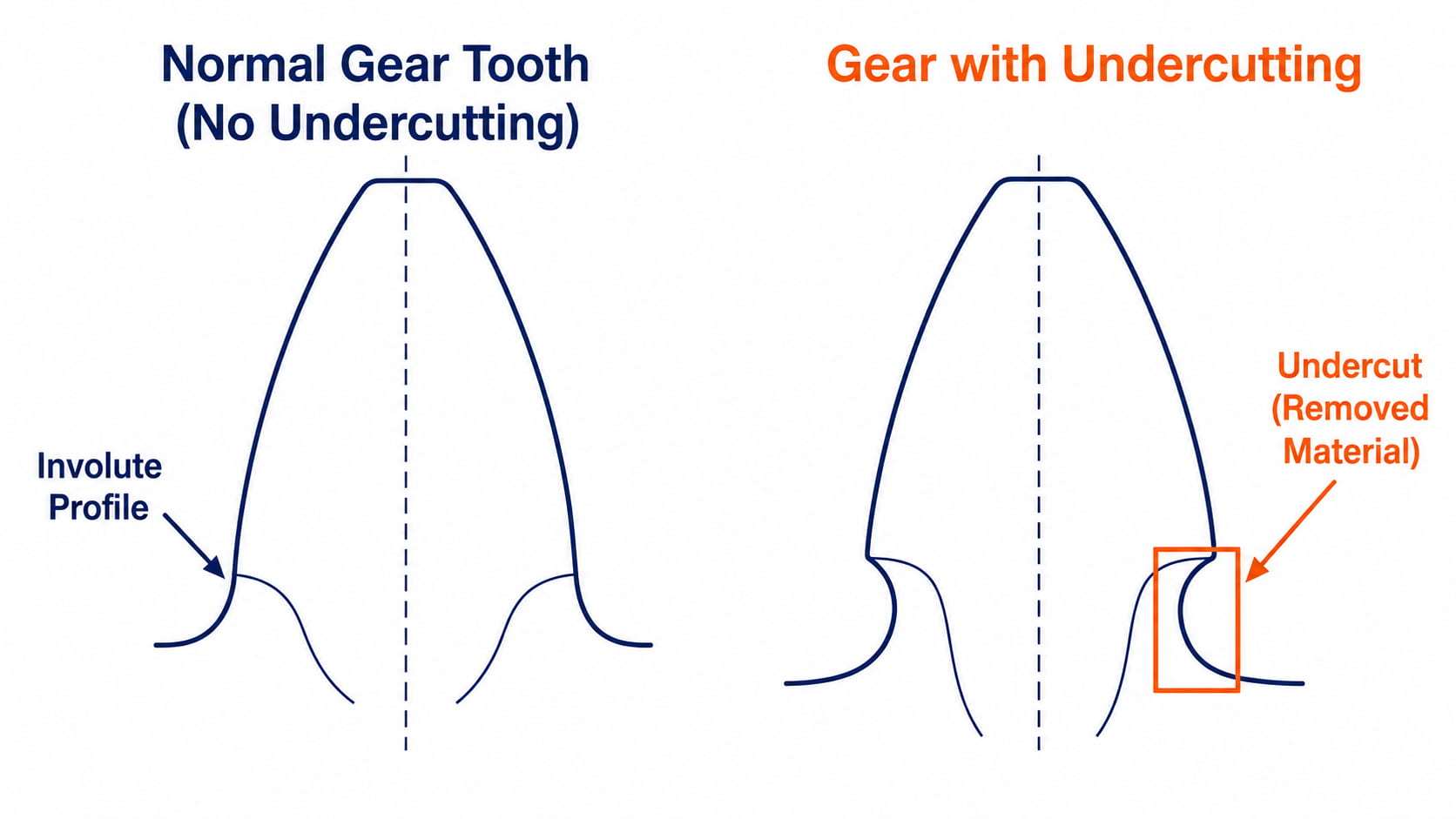
Gear undercutting means that during gear machining or tooth profile generation, material near the tooth root is removed excessively, causing the root area to become concave or thinner. It is common in involute gears, especially gears with a small tooth count.
From appearance, undercutting may make the tooth root area look thinner or narrower, or make the effective involute tooth profile shorter. Slight undercutting may be acceptable in some low-load or specific designs, but severe undercutting can reduce tooth root strength and affect gear meshing and service life.
Why Does Gear Undercutting Happen?
Gear undercutting is usually related to gear design, tooth count, cutter geometry, pressure angle, profile shift and gear pair matching. It is more common when the tooth root area is affected during tooth generation.
Gears with a small tooth count are more likely to have undercutting. If a standard full-depth involute gear has too few teeth and no suitable profile shift or tooth form adjustment, too much material may be removed near the tooth root.
A standard tooth form may not fit every application. When tooth count, module, pressure angle or center distance creates undercutting risk, the design may need gear profile shift, pressure angle review or other tooth form adjustment.
During hobbing, shaping or other tooth generation processes, the cutter may interfere with the root area and remove extra material. For small-tooth-count gears or special tooth profiles, cutter selection and process review are important.
Gears should be reviewed as a pair. Mating gear data, center distance, backlash, pressure angle and contact condition can all affect meshing. If only one gear is checked, undercutting or meshing interference risks may be missed.
What Effects Can Gear Undercutting Cause?
The effect of gear undercutting depends on its severity, load, gear material, heat treatment, and application. Slight undercutting does not always cause immediate failure, but severe undercutting may bring several problems.
| Effect | Why It Matters |
|---|---|
| Reduced tooth root strength | The tooth root becomes thinner and may carry less load |
| Higher risk of tooth breakage | Heavy load or shock load may cause root failure |
| Shorter effective tooth profile | Meshing may become less stable |
| Noise or vibration | Poor meshing can increase running noise |
| Uneven wear | Contact may become less stable under load |
| Lower safety margin | The gear may be less suitable for heavy-duty use |
| Replacement mismatch | A copied gear may not match the original meshing condition |
For high-load, shock-load, high-speed, or noise-sensitive projects, undercutting needs more attention. For ordinary low-speed and low-load projects, whether slight undercutting is acceptable should also be confirmed according to the drawing and actual application.
How Does Undercutting Affect Gear Meshing?
Undercutting changes the tooth form near the root area and may reduce the effective involute contact area. As a result, the gear pair may not mesh as smoothly as expected, especially under load.
Tooth Strength and Load Capacity
The tooth root carries bending stress during operation. If undercutting makes this area thinner, the gear may have less load capacity and a higher risk of tooth damage, especially in heavy-load or shock-load applications.
Contact and Running Stability
Undercutting may also affect running stability. If the effective tooth profile is too short, the gear may show more noise, vibration, uneven contact or faster wear during operation.
How Can Gear Undercutting Be Prevented?
Preventing gear undercutting usually requires both design and process review. Buyers do not necessarily need to complete tooth profile design themselves, but they should know which information affects the supplier’s judgment.
Use Positive Profile Shift
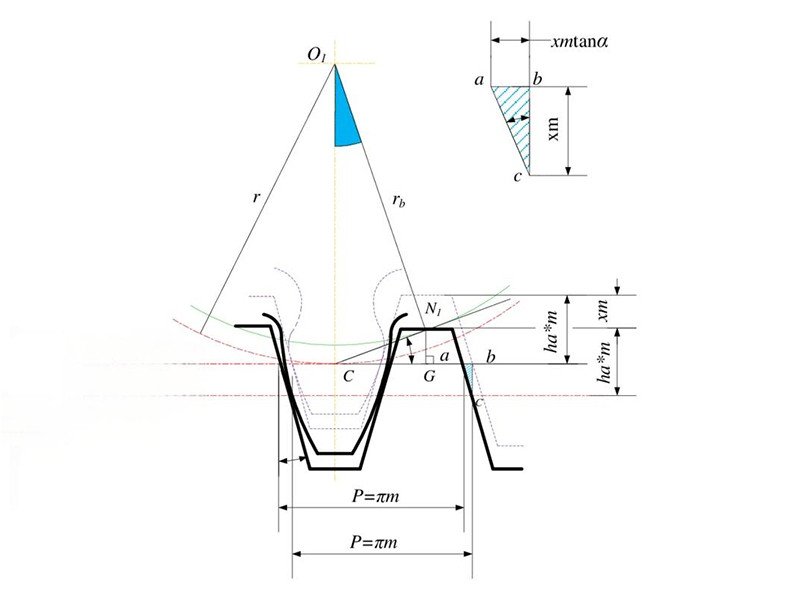
For small-tooth-count gears, positive profile shift is often used to reduce undercutting risk and improve tooth root strength. However, profile shift needs to be reviewed together with the mating gear, center distance, and backlash. It should not be used as an isolated parameter.
Increase Tooth Count When Possible
If the structure allows, increasing tooth count can reduce undercutting risk. However, in replacement gear projects, tooth count is usually limited by the original equipment ratio and mating gear, so it cannot be changed freely.
Review Pressure Angle and Tooth Form
Pressure angle, addendum coefficient, addendum, root structure, and cutter parameters can all affect undercutting risk. For special projects, the supplier needs to review the complete gear data.
Confirm the Gear Pair, Not Only One Gear
Preventing undercutting cannot be done by checking a single gear only. The mating gear, center distance, backlash, assembly space, and working conditions should be confirmed together, especially for replacement gear and old sample reverse engineering projects.
What Should Buyers Check Before Ordering?
| Buyer Check | Why It Matters |
|---|---|
| Drawing or complete gear data | Confirms tooth form and design basis |
| Module or DP | Defines basic tooth size |
| Tooth count | Low tooth count increases undercutting risk |
| Pressure angle | Affects tooth form and force direction |
| Profile shift coefficient | Helps reduce or control undercutting risk |
| Mating gear data | Needed for full gear pair review |
| Center distance and backlash | Affect meshing and contact condition |
| Load and application | Helps judge whether root strength is enough |
| Old sample condition | Worn teeth may hide the original geometry |
| Inspection requirements | Confirms what should be checked before shipment |
If buyers do not have complete drawings, old samples, photos, mating gear information, equipment model, and actual working conditions become more important. Photos can help with initial identification, but judging whether undercutting risk exists usually still requires gear data and sample measurement.
Common Mistakes in Gear Undercutting Review
Treating Undercutting as Only a Manufacturing Defect
Undercutting is not always only a machining error. It may also be related to gear design, tooth count, pressure angle, profile shift, and cutter geometry. Before judging the cause, the complete gear data should be reviewed first.
Checking Only Module and Tooth Count
Module and tooth count are basic information, but they cannot fully judge whether the tooth form is reasonable. For small-tooth-count gears, pressure angle, profile shift, tooth thickness, center distance, and mating gear also need to be confirmed.
Copying a Worn Gear Sample Directly
After long-term use, the tooth surface, tooth root, or tooth thickness of an old sample may already be worn. Copying the old sample directly may copy the worn and incorrect condition into the new gear.
Ignoring the Mating Gear
Undercutting and meshing condition need to be judged in the gear pair. If only one gear is checked without reviewing the mating gear and assembly condition, the actual risk may be misjudged.
Confirming Inspection Too Late
If tooth profile, tooth root, tooth thickness, or contact condition inspection is requested only after production is complete, acceptance and lead time may be affected. Key gear inspection before shipment requirements should be confirmed during the RFQ stage.
How PairGears Reviews Gear Undercutting Risks
PairGears reviews undercutting risk together with drawings, 3D models, old samples, sample photos, module or DP, tooth count, pressure angle, profile shift, tooth thickness, center distance, backlash, mating gear data, material, heat treatment and application conditions.
Review Gear Data
Check tooth count, module or DP, pressure angle, profile shift and tooth thickness.
Review the Old Sample
Check whether wear at the tooth root or flank may hide the original geometry.
Review the Gear Pair
Confirm mating gear condition, center distance, backlash, assembly feedback and load conditions.
Confirm the Next Step
Sample measurement, reverse engineering, pair review or first-article confirmation may be needed.
For replacement gear projects, PairGears does not judge production feasibility only from outside diameter, tooth count or photos. Old sample wear, mating gear condition, assembly feedback and load conditions are also reviewed together.
If the project involves small-tooth-count gears, abnormal meshing, weak tooth roots, noise or old gear reverse engineering, sample measurement, reverse engineering, gear pair review or first-article confirmation may be needed before quotation or production. Buyers can also prepare the information needed for a custom gear quote before sending the project for review.
FAQ About Gear Undercutting
What is gear undercutting?
Gear undercutting means material near the tooth root is removed in a way that makes the root thinner or shortens the effective involute tooth profile. It is more common in small-tooth-count gears.
Is gear undercutting always a problem?
Not always. Slight undercutting may be acceptable in some low-load applications, but severe undercutting can reduce tooth root strength and affect meshing.
What causes gear undercutting?
Common causes include low tooth count, standard tooth design without adjustment, cutter interference, unsuitable pressure angle, missing profile shift review and incomplete gear pair confirmation.
How can gear undercutting be prevented?
It can often be reduced by using positive profile shift, increasing tooth count when possible, adjusting tooth form, reviewing pressure angle and checking the full gear pair.
What should buyers send for undercutting review?
Buyers can send drawings, gear data, module or DP, tooth count, pressure angle, profile shift information, center distance, mating gear data, old sample photos and application details.
Conclusion
Gear undercutting matters because it can reduce tooth root strength, affect meshing stability and increase the risk of noise, wear or tooth damage. It is especially important in small-tooth-count gears, replacement gears and projects without complete drawings.
For buyers sourcing custom or replacement gears, undercutting should be reviewed together with gear data, mating gear condition and application requirements.
Review the Tooth Root Before Production
If a project involves small tooth count, unclear drawings, worn samples or meshing problems, buyers can contact PairGears with drawings, sample photos, tooth data, mating gear information and load conditions for an initial review before quotation, sample measurement or further technical confirmation.