Cog vs Gear vs Cogwheel: What Is the Difference?
If you search for mechanical parts, you may come across three terms: cog, gear, and cogwheel. They are closely related, and people sometimes use them to describe the same thing. But are they really the same?
A cog can refer to one tooth on a toothed wheel. It can also mean a complete toothed wheel in everyday English. A cogwheel is a wheel with several teeth around its edge, while a gear is the common technical term used in mechanical engineering.
For engineers and buyers, this difference is worth understanding. It helps when reading drawings, discussing replacement parts, and asking manufacturers for quotations. At PairGears, we manufacture custom gears and transmission components for different industrial applications. Clear product descriptions help us understand what customers actually need.
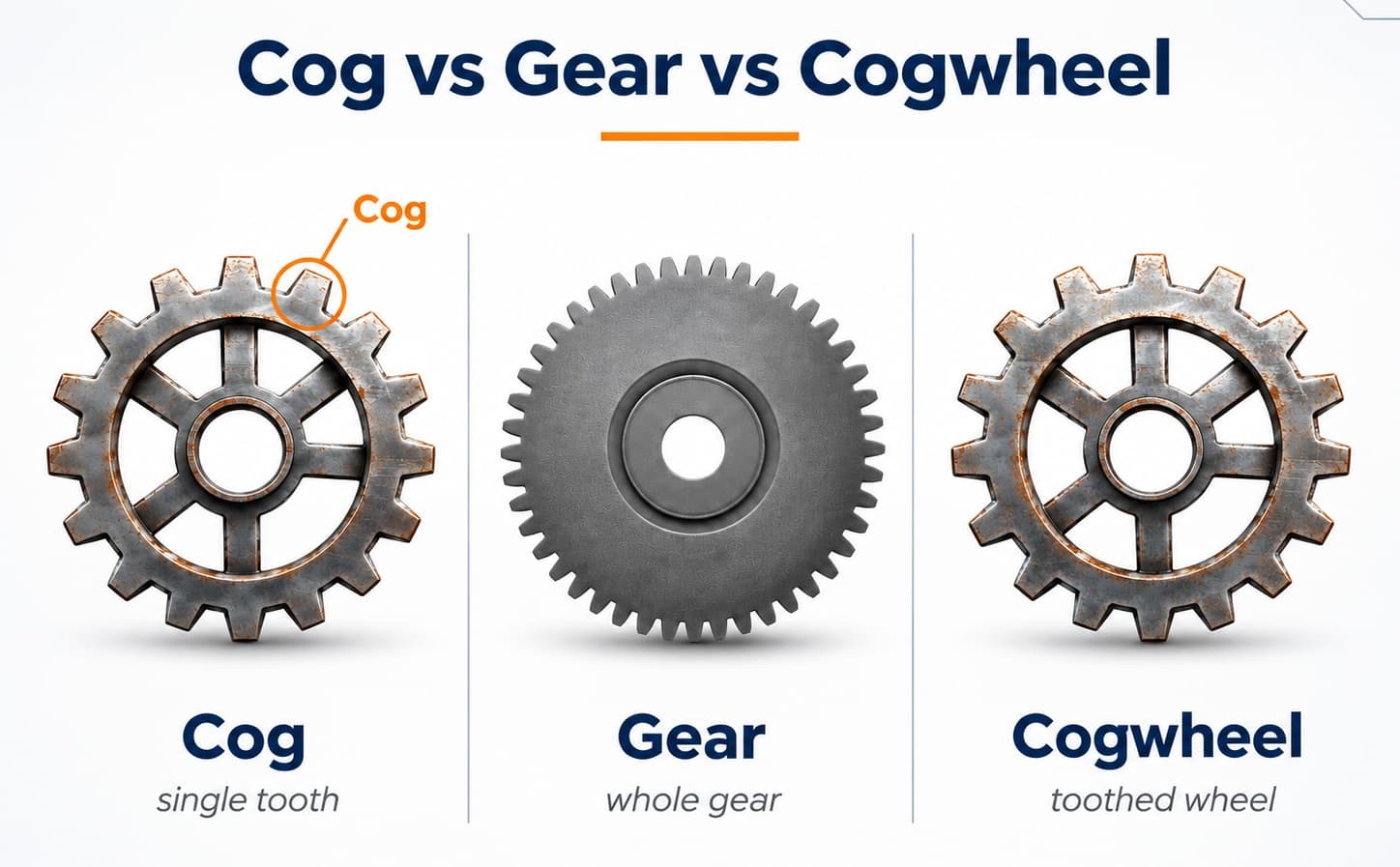
One tooth, or an informal name for a toothed wheel.
The standard engineering term for a toothed transmission component.
A complete wheel with teeth around its circumference.
What Is a Cog?
A cog is a small tooth or projection on the edge of a wheel. It fits into the spaces between the teeth of another toothed component, allowing the two parts to transfer movement.
In everyday English, people also use cog to describe the whole toothed wheel. This is why you may hear someone call a gear a cog.
Common Features of a Cog
- It can refer to one tooth on a wheel.
- It can also describe a complete toothed wheel in everyday conversation.
- It is often used when talking about simple mechanical systems.
- It does not tell you the gear's size, material, accuracy, or load capacity.
What Is a Gear?
A gear is a mechanical part with teeth that transfer movement and torque by engaging with another gear or compatible toothed component.
You can find gears in car transmissions, tractors, industrial machines, construction equipment, and electric vehicle drivetrains. Unlike cog, gear is the standard term used in engineering drawings, product specifications, and manufacturing discussions.
Common Types of Gears
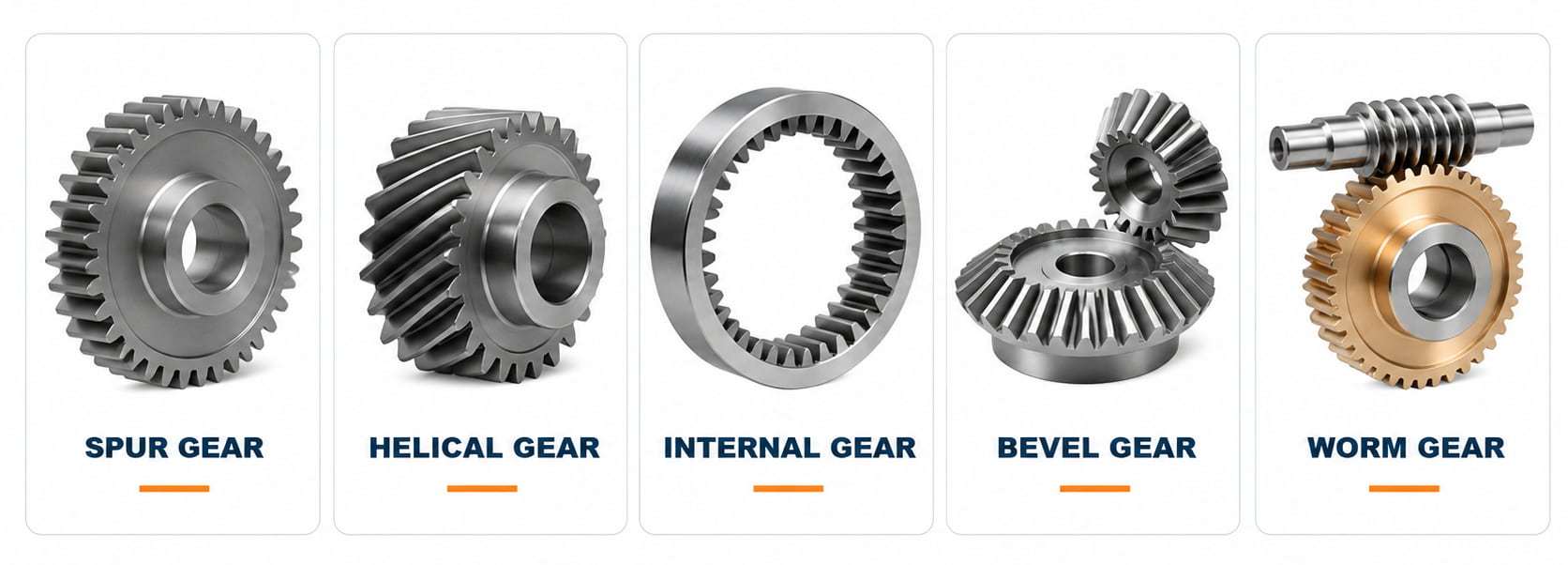
Gears come in different shapes. Each type is designed for a particular transmission arrangement.
Spur Gears
Spur gears have straight teeth that run parallel to the shaft. They are commonly used in simple transmission systems with parallel shafts. Read more about spur gear design.
Helical Gears
Helical gears have teeth cut at an angle. The teeth engage gradually, making them suitable for applications that need smooth power transmission. See our guide to helical gear types and applications.
Bevel Gears
Bevel gears have teeth arranged on a cone-shaped surface. They transfer power between intersecting shafts, often at 90 degrees. Spiral bevel gears are commonly found in differentials and axle drive systems.
Worm Gears
A worm gear set consists of a worm and a worm wheel. It is often used when a machine needs a large speed reduction in a compact space. Learn more about how worm gears work.
Internal Gears
Internal gears have teeth on the inside of a ring. They are often used in planetary gear systems and compact reducers.
The right gear type depends on the shaft arrangement, required speed ratio, load, and available installation space.
What Makes a Gear a Precision Gear?
Not every gear needs the same level of accuracy. A simple gear used in a light-duty machine has different requirements from one used in a truck transmission or an EV drivetrain.
For example, incorrect gear tooth thickness can affect backlash and how two gears fit together.
Gear accuracy also depends on how the part is machined, heat-treated, finished, and inspected. Our article on gear accuracy control explains how these steps affect the finished product.
What Is a Cogwheel?
A cogwheel is a wheel with several teeth around its outer edge. These teeth engage with another toothed part to transfer movement.
In many situations, cogwheel and gearwheel mean almost the same thing. Both describe a wheel-shaped component with teeth.
Common Features of a Cogwheel
- It has several teeth around its circumference.
- It works with another toothed component.
- It transfers rotational movement.
- Its accuracy and strength depend on its design and manufacturing.
Cog vs Gear vs Cogwheel: Key Differences
Now that we have looked at each term, let's compare them.
| Comparison | Cog | Gear | Cogwheel |
|---|---|---|---|
| Basic meaning | A tooth or an informal name for a toothed wheel | A toothed mechanical component | A wheel with several teeth |
| Common use | Everyday English | Engineering and manufacturing | General mechanical descriptions |
| Can refer to one tooth? | Yes | Usually no | No |
| Can refer to a complete wheel? | Sometimes | Yes | Yes |
| Defines manufacturing accuracy? | No | No | No |
| Common technical wording | Gear tooth | Gear or specific gear type | Gearwheel |
The easiest way to remember the difference is:
- Cog can mean one tooth or a toothed wheel.
- Gear is the general technical name for a toothed transmission part.
- Cogwheel describes a complete wheel with teeth.
In practice, the terms can overlap. The important thing is to describe the actual component clearly, especially when it needs to be manufactured or replaced.
Another related term is pinion. In a gear pair, the pinion is usually the smaller gear. See our article on gear vs pinion and their differences for a closer explanation.
Cog vs Gear vs Sprocket: What Is the Difference?
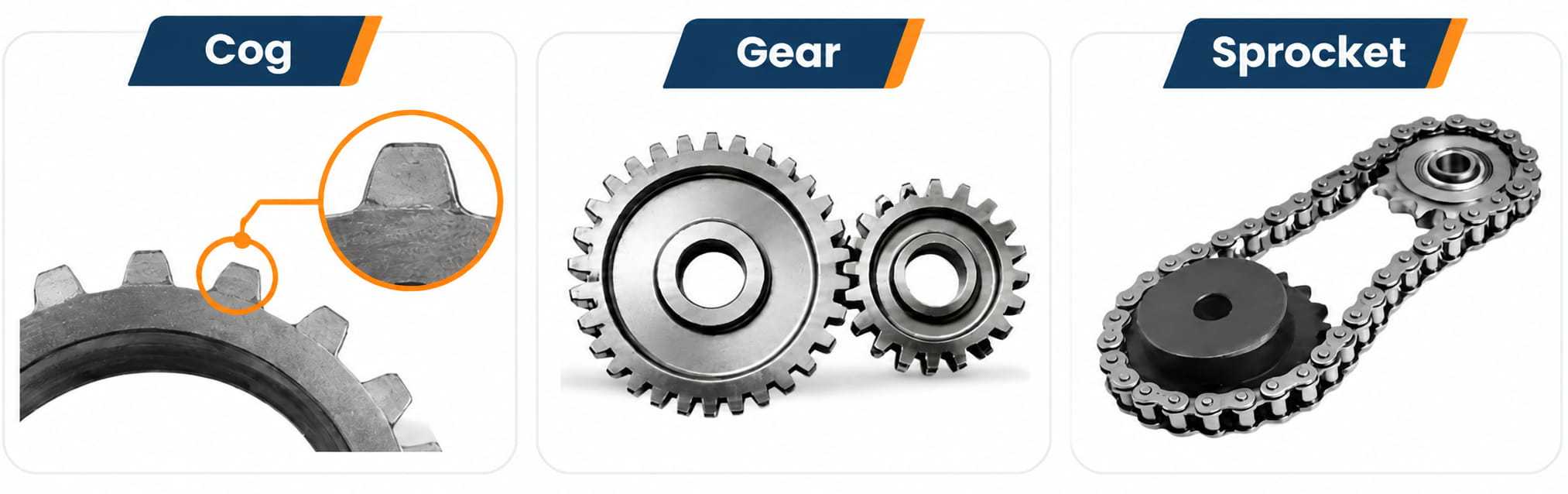
Sprocket is another word that people sometimes confuse with cog and gear. At first glance, they look similar because all three can have teeth. But gears and sprockets work in different ways.
Gear Transmission
Two gears transfer power through direct contact between their teeth. When one gear rotates, it drives the other gear. This changes the speed, torque, or direction of movement, depending on the gear arrangement.
Sprocket Transmission
A sprocket works with a chain. The chain fits around the sprocket teeth and transfers power between two separated shafts.
Common Gear Transmission Applications
- Automotive transmissions.
- Industrial gearboxes.
- Agricultural machinery.
- Construction equipment.
- EV reduction systems.
Common Sprocket Transmission Applications
- Bicycles and motorcycles.
- Conveyor systems.
- Agricultural equipment.
- Material handling machinery.
- Industrial chain drives.
| Feature | Gear | Sprocket |
|---|---|---|
| Transmission | Direct gear meshing | Chain drive |
| Needs a chain? | No | Yes |
| Tooth design | Based on gear geometry | Designed to match the chain |
| Typical parameters | Module, pressure angle, tooth count | Chain pitch, roller diameter, tooth count |
| Common use | Gearboxes and reducers | Chain transmission systems |
A sprocket cannot replace a gear just because both have teeth. Their shapes and working principles are different.
If you need to identify or replace a chain drive component, our guide on choosing the right sprocket for a roller chain explains which dimensions to check.
Which Term Should Engineers and Buyers Use?
When talking about a machine, using the word gear is usually enough for a general discussion.
However, when ordering a replacement part or requesting a custom gear quotation, you need to be more specific. Simply asking for a gear does not tell the manufacturer whether you need a spur gear, helical gear, bevel gear, or internal gear.
What Information Should You Provide?
| Information | What to Include |
|---|---|
| Gear type | Spur, helical, bevel, internal, etc. |
| Tooth details | Module or DP, tooth count, pressure angle |
| Main dimensions | Face width, bore, outside diameter |
| Material | Material grade or drawing requirements |
| Heat treatment | Carburizing, induction hardening, nitriding, etc. |
| Accuracy | Required ISO, DIN, or AGMA grade, if specified |
| Application | Gearbox, agricultural machinery, truck transmission, EV drivetrain |
| Quantity | Sample, trial order, or annual demand |
You do not always need to provide every detail at the first stage. If you do not have a drawing, a physical sample, clear photos, and some basic dimensions can still help the manufacturer understand the part.
For a more detailed explanation of the manufacturing stages, see our guide to gear cutting processes and applications.
Custom Gear Manufacturing for Industrial Applications
A gear may look like a simple round metal part, but making one that fits and works correctly requires more than cutting teeth.
The manufacturer needs to understand where the gear will be used, what load it will carry, and how it will work with other components.
At PairGears, we produce custom gears and shafts for four main application sectors:
Depending on the design, production may include CNC machining, gear cutting, heat treatment, shaving, grinding, and dimensional inspection.
The process is selected according to the drawing, material, accuracy requirements, and actual working conditions. Not every gear needs the same manufacturing route.
For customers developing new parts or replacing existing components, we can review drawings and physical samples to help clarify the technical requirements before production.
Frequently Asked Questions
Is a cog the same as a gear?
Not exactly. Cog can refer to one tooth on a wheel or an entire toothed wheel in everyday English. Gear is the standard technical term used in mechanical engineering.
Is a cogwheel the same as a gearwheel?
In many situations, yes. Both terms describe a wheel with teeth around its circumference. Gearwheel is generally more common in technical descriptions.
Is a cogwheel less accurate than a modern gear?
No. The name does not determine accuracy. Gear precision depends on the design, manufacturing process, tolerances, and inspection requirements.
What is the difference between a gear and a sprocket?
A gear transfers motion through direct engagement with another gear. A sprocket works with a chain. They are used in different transmission systems.
What information do I need to order a custom gear?
A drawing or physical sample is the best starting point. You should also provide the gear type, tooth count, module or DP, material, heat treatment, application, and required quantity if available.
Conclusion
Cog, gear, and cogwheel are closely related terms, but they are not always used in the same way. Cog can describe an individual tooth or a complete toothed wheel in everyday language. Cogwheel describes a wheel with multiple teeth, while gear is the common technical term in mechanical engineering.
When discussing or ordering mechanical parts, it is better to describe the actual gear type and provide the necessary technical details. This helps avoid confusion during drawing review, quotation, and production.
If you need custom gears for an industrial application, contact PairGears with your drawing, sample, or product photos. Our team can review your requirements and discuss a suitable manufacturing solution.
Looking for a Custom Gear Manufacturing Partner?
Share your drawing, physical sample, or product photos with PairGears. Our team can review the gear type, key technical details, application and manufacturing requirements before quotation.